
 Available in US
Content

An NHL moneyline is the simplest bet on the board — you back one team to win the game outright, no goal cushion involved. That’s its appeal and its trap. The price is fixed when you take it. The bookmaker doesn’t move the cover bar the way it does for football handicaps. What looks like a clean ‘who wins’ question hides some of the worst long-run returns in hockey once you start backing the wrong side at the wrong price.
Home teams in the NHL win their moneyline games at roughly 54 percent across the recent data — slightly better than coin-flip but not by enough to bet blindly. That single number is the starting point for everything that follows in this guide, because if you can’t beat the implied probability that 54 percent suggests, you can’t beat the market.
I’ve spent nine years building moneyline models for the NHL from a UK base. My approach is mathematical first. Every price gets converted to implied probability before I look at the matchup, regardless of whether the book shows fractional, decimal or American notation. If you don’t think in terms of implied probability, you’re guessing. If you do, the moneyline becomes one of the most readable markets on the board.
The natural point of comparison is the puck line. Both are NHL bets on the same game, both are offered on every UKGC-licensed sportsbook, and they answer different questions. The puck line locks in a fixed 1.5-goal spread and moves the price. The moneyline locks in a fixed outcome — team wins — and moves the price to balance the implied probability. Same instrument, different chassis.
Across the rest of this guide I’ll walk through the mechanics of moneyline pricing, how to translate American notation into UK fractional, how the 2-way and 3-way markets differ on overtime settlement, where favourites overprice themselves, and the matchups where backing a dog at +180 pays out across a long sample.
Reading a Moneyline Price the UK Way
Pull up any NHL game tonight on a UK sportsbook and you’ll see a price like +135 next to one team and -160 next to the other. Those numbers aren’t probabilities and they aren’t multipliers. They’re the bookmaker’s price tag on each outcome, written in three different languages depending on where you’re looking. Decoding them is step one for any UK punter who wants to think in terms of value rather than vibes.
Plus and Minus Pricing
American notation uses positive numbers for underdogs and negative numbers for favourites. The size of each number tells you what £100 either wins or stakes.
A +135 underdog means you stake £100 to win £135 in profit — a £235 total return if you’re right. A -160 favourite means you stake £160 to win £100 in profit — a £260 total return if you’re right. The asymmetry is the price difference. Backing the favourite at -160 implies the bookmaker thinks they win about 61.5 percent of the time. Backing the +135 dog implies the dog wins about 42.6 percent. Add those together — 104.1 percent — and the overshoot is the vig, the bookmaker’s built-in margin on the market.
UK Fractional Translations of American Moneylines
On a UK card those same American prices appear as fractions. +135 reads as 27/20, or 5/4 when the book is rounding. -160 reads as 5/8 or 13/20. Harder to parse at a glance.
The arithmetic relationship: for a positive American line, fractional equals American divided by 100, so +135 is 135/100, which simplifies to 27/20. For a negative American line, fractional equals 100 divided by the absolute value, so -160 is 100/160, which simplifies to 5/8. UK bookmakers do that conversion automatically. You don’t need to do the maths in real time. You do need a feel for the conversions so you can compare across books quickly.
My quick reference, the same one I built nine years ago and still keep on my desk: 4/5 equals -125 American. Evens or 1/1 equals +100. 11/10 equals +110. 6/4 equals +150. 5/2 equals +250. Anything beyond that and I default to decimal — fraction plus one — which is the same number that runs on the exchanges.
Calculating Payout for a £25 Stake
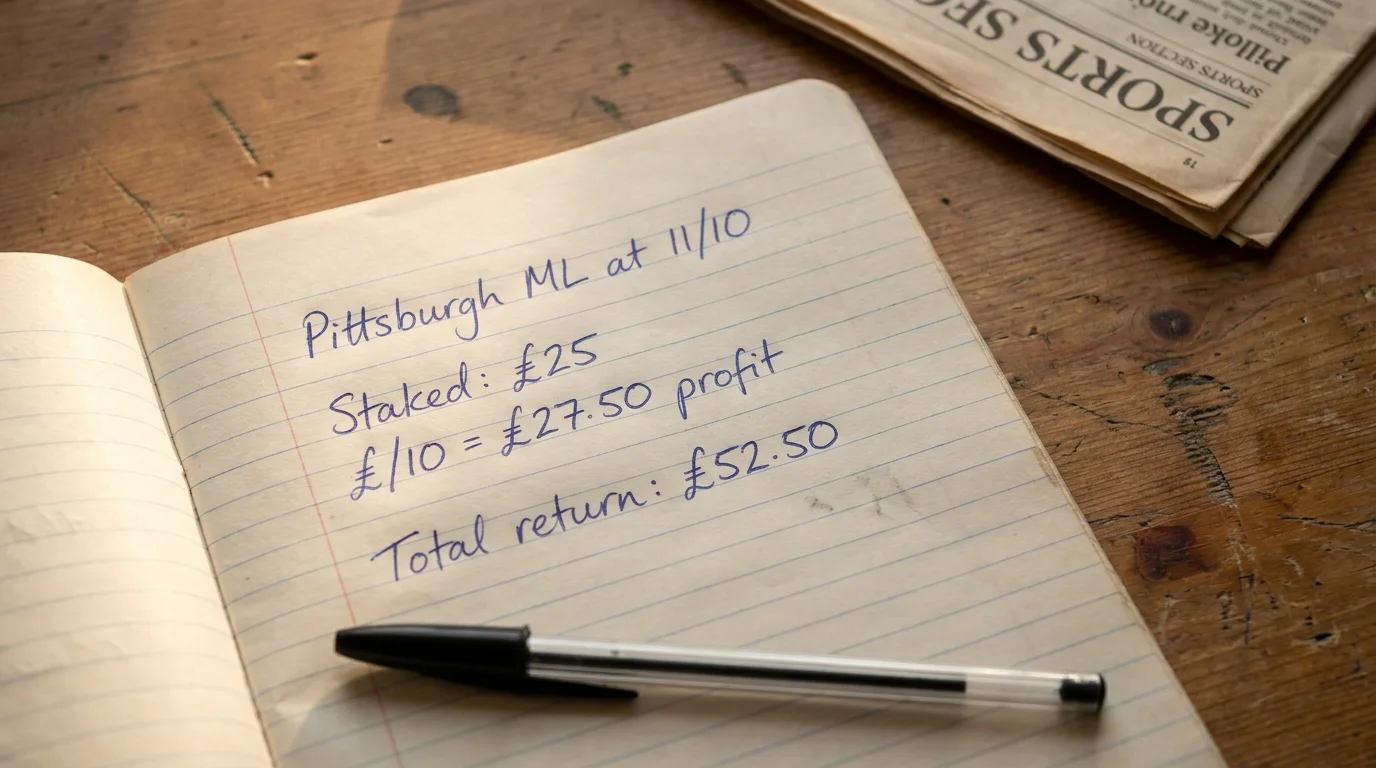
Take a Pittsburgh moneyline at 11/10 on a UK card. You stake £25. The fractional 11/10 pays £11 profit for every £10 staked. Your £25 stake at 11/10 returns £27.50 in profit plus the £25 stake — £52.50 total.
Cross-check it in decimal. 11/10 in decimal is 2.10. £25 multiplied by 2.10 equals £52.50. Same number, two formats.
If you’d taken the same Pittsburgh at -110 American instead — equivalent to 10/11 fractional — your £25 returns roughly £47.73 total, or £22.73 profit. The difference between 11/10 and 10/11 looks small on the card, but on a £25 stake it’s nearly £5. Across 200 NHL bets in a season, that single price gap is the difference between breaking even and turning a small profit.
The 2-Way and the 3-Way Markets
NHL games end in three different ways: regulation, overtime, or shootout. UK bookmakers turn that into two completely different moneyline markets, and most casual punters have no idea they’re betting on the wrong one.
What 2-Way Means in NHL Betting
The 2-way moneyline is the default product on every UKGC-licensed sportsbook. It settles on the final result of the game — regulation, overtime or shootout, doesn’t matter — and pays one team or the other. There are no draws. If Toronto and Detroit end regulation tied at 2-2 and Toronto wins in a shootout, a 2-way Toronto moneyline pays out at the price you took. The ‘who wins the game’ question collapses overtime and shootout into the final result.
How the 3-Way Market Handles Overtime
The 3-way moneyline is the same bet shifted onto regulation only. Three outcomes: home win in regulation, away win in regulation, or draw after 60 minutes. If Toronto and Detroit are 2-2 after the third period and Toronto wins in overtime, the 3-way ‘draw’ selection pays — neither team won the regulation portion outright.
NHL games end tied in regulation roughly 23.9 percent of the time. That’s almost one game in four. On the 2-way market, that overtime is irrelevant — the eventual winner pays out at the price they took. On the 3-way market, those 23.9 percent of games settle on the draw line, regardless of who wins in OT or the shootout.

When the 3-Way Is Genuinely Better Value
Two situations. First, when you genuinely think the game is heading to overtime — a low-scoring matchup between two defensive teams with strong goaltending. The draw price on a 3-way market is often +290 or longer because most punters ignore it, but if you’re right about the regulation finish you’re collecting a heavily inflated number.
Second, when the home favourite is priced sharply on the 2-way market but the regulation-only price is more reasonable. On 2-way you might see Boston at -180 against Buffalo. On 3-way the Boston regulation win might pay -130. If you think Boston wins the game but the matchup is competitive enough to go to overtime now and then, the 3-way price on regulation is mathematically the better number.
For a full deep-dive on the 3-way mechanic — how the price spreads across the three outcomes and the spots where the draw selection genuinely outpaces both moneylines — see the 3-way moneyline guide. For the rest of this article I’ll stay on the 2-way product, which is what 90 percent of UK punters bet.
Reading Favourites and Underdogs at the Moneyline
In nine years of tracking NHL moneylines, the single most consistent way I’ve watched UK punters lose money is by backing heavy favourites every night. The maths is brutal. A team at -300 needs to win two-thirds of the time just to break even. Most -300 favourites don’t reach that threshold once you factor in goaltending matchups, schedule, and the strange way NHL games actually end.
Reading Heavy Chalk in NHL
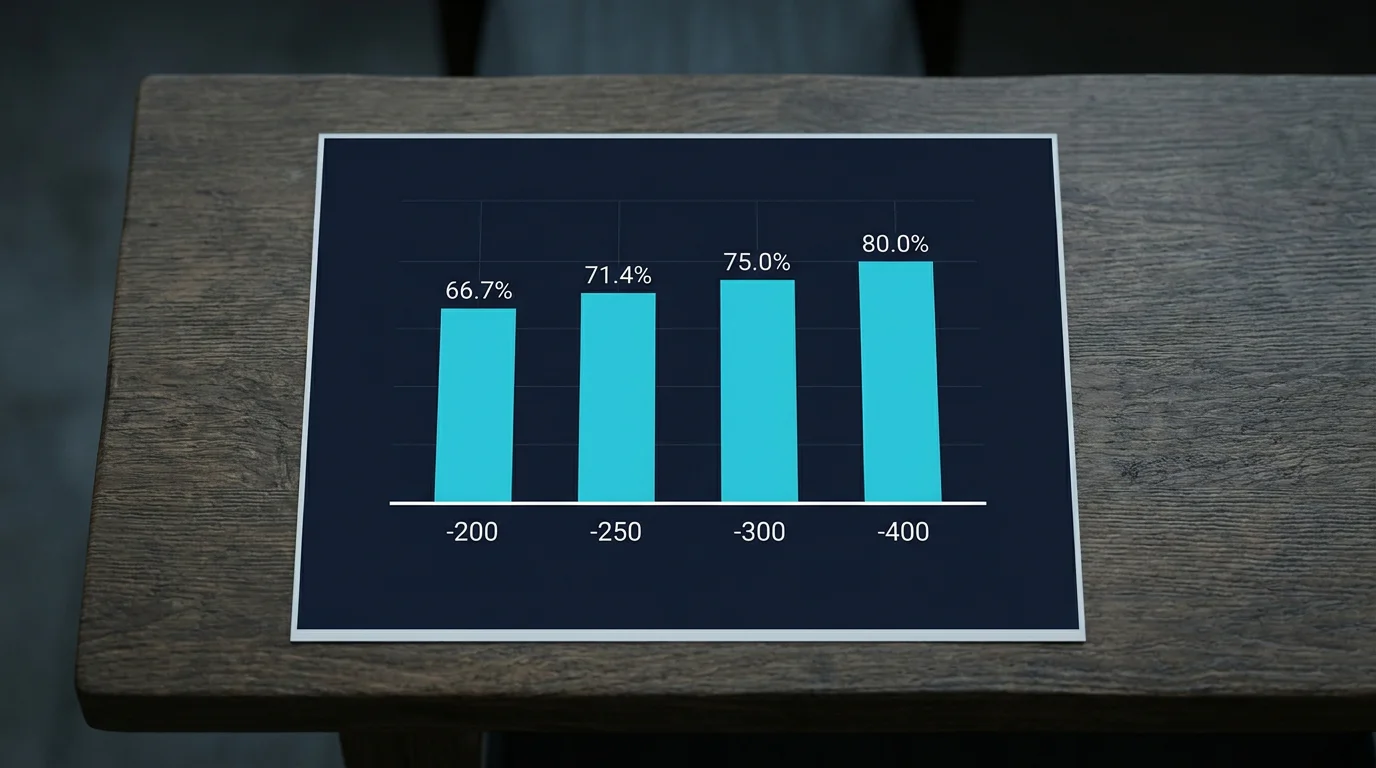
A ‘chalk’ favourite is a heavy short-price team — -200 and shorter. The implied probability at -200 is 66.7 percent. At -250 it’s 71.4 percent. At -300 it’s 75 percent. At -400 it’s 80 percent. Look at how steep the bar climbs.
Then factor in the structure of NHL hockey. Roughly one game in four ends in overtime or shootout — a flip of a coin once the third period runs out. Goaltending swings 30 to 50 percent of close games. A team priced at -300 isn’t winning 75 percent of those games unless the matchup is absurdly lopsided, which the market usually identifies in advance. The best you’ll get from chasing chalk every night is break-even after vig, and the most likely outcome is a slow bleed.
When the Home Favourite Is Overpriced
Home moneylines in the NHL win at about 54 percent — slightly better than a coin flip but not by much. The home edge is real, the home edge is roughly 0.28 goals per game, and the home edge produces 54 percent winners. What it does not produce is justification for -180 to -200 prices on home favourites in close matchups.
When the home team is the better team on paper, the price runs up. UK punters often pay -190 on a home team that wins maybe 58 percent of the time once you correct for all the variables. That’s a -190 price on a 58 percent winner. The breakeven on -190 is 65.5 percent. You’re paying seven percentage points of vig you didn’t see.
The corollary: home dogs at +140 to +180 are often a stronger play, especially when the home dogs in question cover at 63.9 percent on +1.5 puck lines. If they’re covering the spread that often, they’re winning a meaningful subset of those games outright. Backing the +150 dog instead of paying -190 on the chalk is one of the bedrock UK sharp plays.
Underdog Moneylines Worth Backing
Underdog moneylines that I’ll actually back fall into three buckets. First: home dogs with a confirmed top-six goaltender. The goalie matchup overrides the team-level disadvantage on a substantial percentage of nights. Second: rested dogs facing tired favourites on the back end of a back-to-back. The schedule edge is one of the most underpriced angles in the sport. Third: dogs whose price has drifted because of overnight news the market has overreacted to — a healthy scratch that turns out to be precautionary, a goalie listed as a game-time decision who ends up playing.
None of those plays come with guarantees. Underdog moneylines lose more than half the time by definition. The point is that the price at +150 to +200 compensates you for the risk in a way that paying -190 to -250 on the favourite never can.

Turning Moneyline Odds Into Probability
Every NHL moneyline price translates to an implied win probability. If you can do that conversion in your head, you’re already ahead of most UK punters. If you can’t, you’re guessing whether the price is fair — and guessing isn’t a strategy.
From Odds to Probability — The Formula
The maths is short. For a negative American moneyline like -160, the implied probability is the absolute value divided by the absolute value plus 100. So -160 becomes 160 divided by 260, which is 61.5 percent.
For a positive American moneyline like +135, the implied probability is 100 divided by the moneyline plus 100. So +135 becomes 100 divided by 235, which is 42.6 percent.
UK fractional uses a slightly different formula: divide the right side of the fraction by the sum of both sides. 4/5 becomes 5 divided by 9, or 55.6 percent. Evens (1/1) becomes 1 divided by 2, or 50 percent. 11/10 becomes 10 divided by 21, or 47.6 percent. 5/2 becomes 2 divided by 7, or 28.6 percent.
Decimal is the easiest of the three: implied probability equals one divided by the decimal price. 1.80 equals 55.6 percent. 2.50 equals 40 percent. 3.50 equals 28.6 percent.
How to Spot Positive Expected Value
Positive expected value, or +EV, is the gap between your estimate of the true probability and the bookmaker’s implied probability.
Say you think a team wins 55 percent of the time and the moneyline is priced at +110 (implied probability 47.6 percent). Your edge is 55 minus 47.6, which is 7.4 percentage points. Multiply that edge by your stake and that’s your expected return over the long run on that bet.
The trick is being honest about your estimate. Most punters overestimate their team’s chance. I keep my projected probabilities to five percent increments — I never write 53.5 percent. Either the matchup is 50 percent and I’m not betting, or it’s 55 percent and the +110 price has an edge, or it’s 60 percent and I’m hammering it. Anything inside 50-55 percent is too close to the vig to matter and I usually pass.

Vig and How It Inflates Implied Probability
The vig — or juice, or hold percentage — is the bookmaker’s built-in margin. It’s the reason the two sides of an NHL moneyline never quite add up to 100 percent of probability.
A typical NHL game might price the favourite at -160 (61.5 percent implied) and the underdog at +135 (42.6 percent implied). Together those add to 104.1 percent. The 4.1 percent overshoot is the vig — the bookmaker’s edge if equal money is bet on both sides.
The juice can run heavier than that on UK books. Some operators carry 6 to 8 percent vig on NHL moneylines, especially on coin-flip games where they’re hedging exposure. The lower the vig, the better the price for you. Open three books on the same game, take the price with the lowest combined overround, and you’ve already done more for your bottom line than the average punter does in a year.
When the Moneyline Is the Right Pick
There’s a clip I keep coming back to. After Game 1 of this year’s Stanley Cup Final, with Vegas having taken Carolina apart, a BetMGM trading manager summarised the desk’s view in five words: “At this point, we’re hoping Carolina can get it done.” That’s a bookmaker quietly admitting that the moneyline market is taking heat from the public on the team they need to lose. It’s also a tell that the moneyline — the simplest bet on the board — is where the public-versus-sharp pressure lives.
Confident Underdog Picks
The moneyline beats the puck line on underdogs you actually think will win outright. If you’re 55 percent confident a +180 dog wins, the moneyline returns roughly £100 profit on a £55 stake. The +1.5 puck line returns about £35 on the same stake. Same outcome, very different payoff. When the confidence is genuine, you take the moneyline.
The catch is that confidence is rare. I bet outright dogs maybe a dozen times across a full regular season. The rest of the time I’d rather buy the +1.5 cushion and accept the lower payoff.
Avoiding Heavy Favourites at -250 and Shorter
This is the rule I’d press hardest on a UK beginner. Don’t back -250 and shorter favourites on the moneyline. The implied probability at -250 is 71.4 percent. The implied probability at -300 is 75 percent. Across a long sample, those teams don’t reach those probabilities reliably enough to break even after vig.
The puck line at -1.5 is almost always the better bet on a heavy chalk favourite. You’re trading certainty (the favourite wins) for a buffer requirement (the favourite wins by two), and the price improvement compensates you for that trade. -250 moneyline becomes -110 to -130 on the -1.5 puck line. That’s a better wager almost every time.
Combining Moneyline With Totals
The other clean use of the moneyline is in same-game combinations with the total. If you think Edmonton wins and the game goes over 6.5, you can package those two legs into a same-game parlay or bet them as separate stakes.
The separate-bets approach is mathematically simpler and lets you treat each price on its merits. The parlay approach pays more if both legs hit, but the price is correlated — Edmonton winning makes the over more likely — and the bookmaker prices that correlation in. UK bookmakers offer same-game parlays on every product now, and the prices on correlated legs are usually inflated by 10 to 20 percent over what you’d get by betting them separately.
Pick your spots. If you’ve got high confidence on both legs and the bookmaker is offering a sharp same-game parlay price, take the parlay. If you’ve got confidence on the moneyline only, take it standalone.
The Most Common Moneyline Mistakes I See
I run a quick error log every quarter. Three patterns dominate the column. UK punters who lose money on NHL moneylines almost always lose it in one of these three ways, and once you’ve internalised them, you can audit your own betting in 20 minutes a week.
Chasing Favourites Every Night
The single most expensive mistake in moneyline betting is the assumption that backing the best team in every matchup will turn a profit over time. It doesn’t. The price you pay for that certainty is the vig plus an inflated implied probability that the favourite cannot consistently meet.
I’ve watched bankrolls evaporate over a single February from punters going 7-3 on -200 favourites and not realising they’re break-even at best. 7-3 at -200 with a £100 stake each: seven wins return £350 in profit, three losses cost £600. Net result is minus £250 over ten bets. The 70 percent hit rate looked good on the surface. The maths underneath it killed the bankroll.
Ignoring Rest and Travel
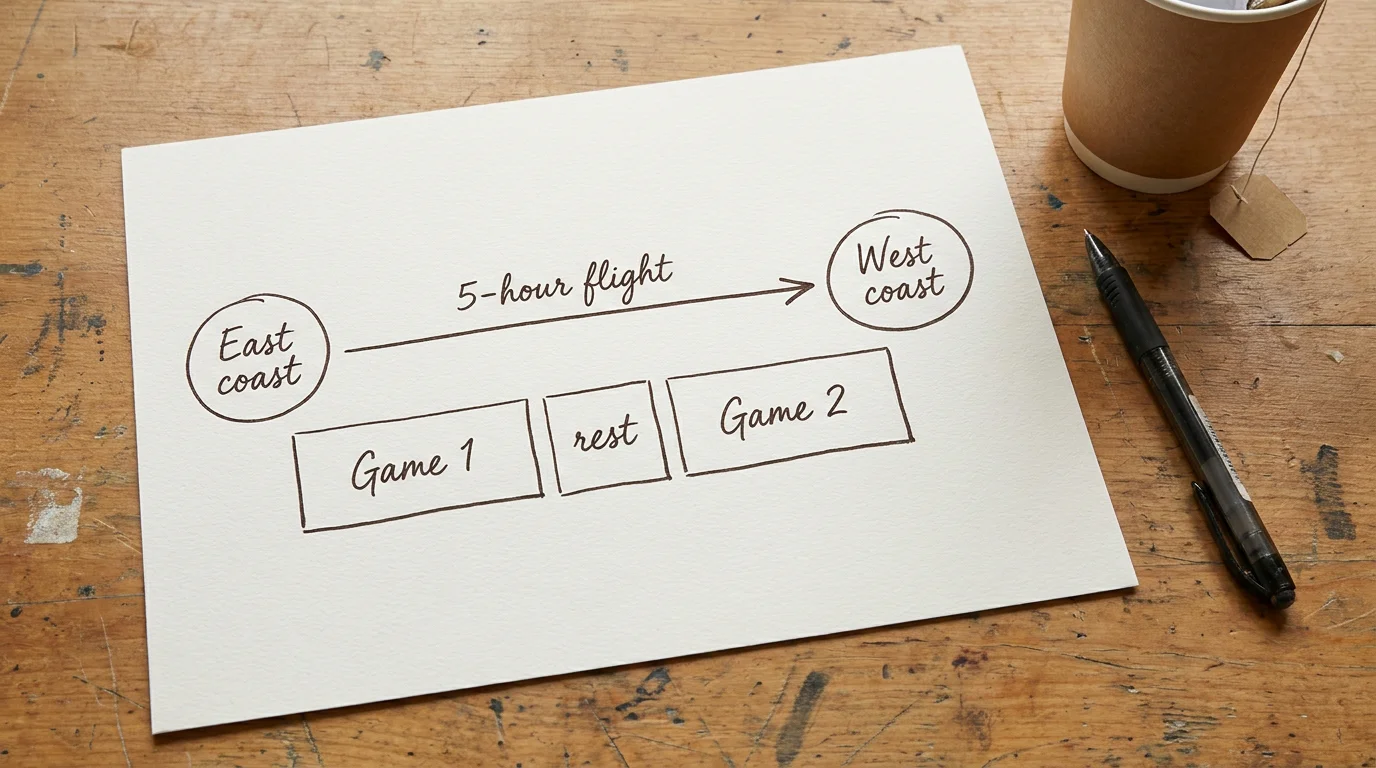
NHL travel is brutal. East-coast teams flying to the west coast for a Saturday-Sunday two-game stint regularly come out flat in the second game. Time-zone changes degrade reaction time, save percentage, and shot quality.
I check rest differential on every moneyline bet. If one team has played in the last 24 hours and the other has had two days off, the rest difference is worth three to five percent on the moneyline price. That edge is rarely priced in fully. UK punters who don’t check rest are giving up that edge every single night.
Confusing 2-Way and 3-Way Price
The third mistake is more subtle. UK bookmakers sometimes display the 2-way moneyline as the default and the 3-way as a separate market further down the page. A punter who’s seen a price of -130 on Boston in the 3-way market — regulation only — doesn’t always realise that the same Boston is -180 on the 2-way market because the 2-way includes overtime and shootout.
If you back Boston in the 2-way thinking the price is -130, then check your slip to find it’s -180, you’ve already given up six percentage points of implied probability you weren’t trying to pay. Always read the line item label. 3-way means regulation only. 2-way means full game.
The Moneyline Framework I Trust on Every NHL Night
After nine years of betting NHL moneylines from a UK base, the decision framework comes down to four steps I run on every game I’m considering. Start at the top and stop the moment one fails — most NHL nights you’ll stop at step two and find yourself with one or two genuine bets on a ten-game slate.
- Step one — convert the price. Read the moneyline in whichever format the book defaults to, then convert it to implied probability. If you can’t get to a percentage in five seconds, the conversion isn’t reflexive enough yet.
- Step two — estimate the true probability. Honest five percent buckets. 50, 55, 60, 65. If your estimate matches the implied probability, there’s no edge and there’s no bet.
- Step three — confirm rest, goaltending, and matchup. One filter at a time. Any disqualifying factor — back-to-back fatigue, backup goalie, lopsided injuries — kills the bet outright.
- Step four — line shop. Three UKGC-licensed books minimum. Take the price with the best edge for you, factoring in the bookmaker’s overall margin on the game.
The framework is unsexy. It’s also the reason my moneyline volume is half what most punters’ is and my hit rate sits at roughly 53 percent on break-even prices — which translates to a small profit after the vig is netted out across a full 1,312-game NHL regular season.
How do you convert a -160 NHL moneyline into implied probability?
Take the absolute value of the moneyline and divide it by the absolute value plus 100. For -160 that’s 160 divided by 260, which equals 61.5 percent. The result is the implied probability that the favourite wins outright. For positive moneylines the formula flips: 100 divided by the moneyline plus 100. So +135 is 100 divided by 235, which equals 42.6 percent. UK fractional uses a slightly different formula — divide the right side of the fraction by the sum of both sides. 4/5 becomes 5 over 9, or 55.6 percent.
Does an NHL moneyline bet include the shootout result?
A standard NHL moneyline on a UKGC-licensed sportsbook settles on the full result of the game — regulation plus overtime plus shootout. If the game ends in a shootout, the team that wins the shootout wins the moneyline. The 3-way moneyline is the separate market that excludes overtime and shootout from settlement and pays out on the regulation result only. Always check the line item label. 2-way includes OT and shootout. 3-way is regulation only, with a third selection for the regulation draw.
Can you bet both teams’ moneylines and lock in a profit?
Only if the two prices combined imply a probability of less than 100 percent, which essentially never happens on a single bookmaker. The vig built into every moneyline market means the two sides usually add to 104-108 percent of implied probability. Where arbitrage does occasionally exist is across different bookmakers — one shop pricing Boston at +110 while another prices Toronto at +120 on the same game can lock in a guaranteed profit of one or two percent on the combined stake. Most UK bookmakers limit accounts that bet arbitrage aggressively, so the strategy has a short shelf life.
Why are short-priced favourites usually a losing strategy over a full NHL season?
A favourite priced at -250 needs to win 71.4 percent of the time just to break even before the bookmaker’s margin. Across the full NHL season very few teams reach that hit rate consistently — schedule, goaltending variance, and the one-in-four games that end in overtime all chip away at the favourite’s structural edge. The maths are unforgiving. A punter who goes 7-3 backing -250 favourites still loses money: seven wins at £100 stake each return £280, three losses cost £750. The 70 percent hit rate looks impressive on the surface and still bleeds the bankroll because of the vig and the implied probability mismatch.
