
 Available in US
Content
- The Licence Is Not a Suggestion, It's the Floor
- The Criteria That Actually Decide NHL-Quality
- The Markets That Should Be on the Page Before You Deposit
- How the Money Actually Moves In and Out
- Reading the Promotion Page Without Getting Played
- The Phone Lines Open at Two in the Morning
- The Signals That Should Make You Close the Tab
- The Checklist I Run Before I Open Any NHL Account

A friend rang me last September asking which was the best NHL betting site in the UK, and I spent the next twenty minutes explaining why the question itself misses the point. He had been refreshing the same three Google rankings of “top NHL bookmakers UK” and getting nowhere, because every list ranked the same five operators in slightly different orders and gave him no actual basis for choosing between them. The honest answer is that there is no single best NHL betting site for UK punters — there are operators that fit specific bettor profiles, and the work of choosing one is the work of matching their NHL-specific features against how you intend to bet hockey.
The UK regulated betting and gaming sector serves around 22.5 million adults monthly across its licensed operators, and 92 percent of all gambling activity in Britain still flows through that regulated market. Those numbers matter for NHL betting more than for any other sport — because NHL games start at midnight UK time, run past 3 am, and are settled across overtime and shootout rules that not every bookmaker handles cleanly. The differences between operators that look identical on a comparison table can mean the difference between a settled ticket at half past two in the morning and a dispute that runs into the next afternoon.
What I want to do across the rest of this guide is walk you through the criteria I use myself — UKGC licensing first, NHL market depth second, live betting and overtime settlement third, payment processing and customer support after that, and the red flags that should disqualify an operator before you deposit a pound. This is a criteria guide, not a rankings post. I’m not going to tell you which book to open. I’m going to give you the framework I use to make that decision myself.
The Licence Is Not a Suggestion, It’s the Floor
I had a long phone call once with a UK bettor who had lost £900 on an offshore site that had taken his deposit, accepted his NHL playoff bets, and then refused to process the withdrawal. There was no recourse. The site wasn’t UKGC-licensed, and his only options were chasing the operator through a foreign jurisdiction or absorbing the loss. He absorbed it. That conversation changed how I think about the licence — it isn’t a regulatory tick-box, it’s the only practical guarantee a UK bettor has that the bookmaker will pay out a winning bet.
What a UKGC licence guarantees
A UK Gambling Commission licence places an operator under a binding legal framework that covers consumer fund protection, advertising standards, dispute resolution, anti-money-laundering checks and responsible gambling obligations. The UKGC has the authority to suspend or revoke licences, impose substantial fines, and order operators to refund customers when rules are breached. None of that is theoretical — the Commission has revoked licences in the last three years from operators that failed AML obligations, and customer refunds have been ordered as part of enforcement settlements. The licence is the foundation that makes every other piece of consumer protection in UK betting actually enforceable.
How to verify a licence number
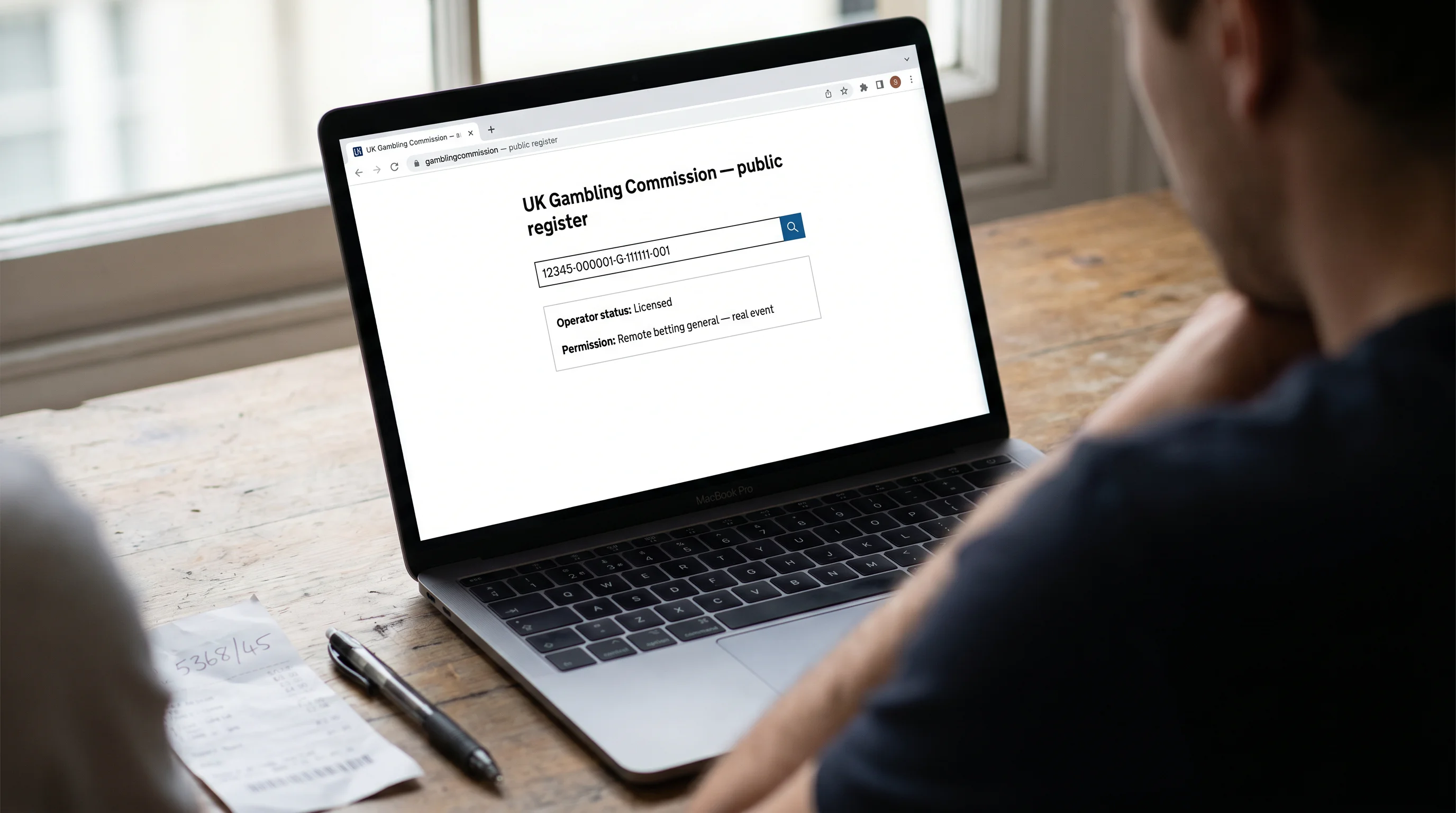
Every UKGC-licensed operator must display its licence number on the footer of its website, and the Commission publishes a public register where you can verify the number, the company name behind it, and the specific permissions the licence covers. The verification takes about ninety seconds. You scroll to the footer, copy the licence number, paste it into the Commission’s register search, and confirm the operator is listed as currently licensed for “remote betting general — real event”. Operators that don’t display a number, or display a number from a different jurisdiction like Curacao or the Isle of Man, do not hold a UKGC licence regardless of marketing copy.
Red flags of unlicensed operators
The UK black market for gambling reached £16.6 billion in 2025, more than three times its 2019 level of £5 billion, and the share of regulated activity dropped from 97 percent to 92 percent over the same window. That five-point shift is the operational reality every UK bettor now navigates — unlicensed sites are more aggressive, better-designed, and more visible in search results than they were a few years ago. The former UKGC chief executive Andrew Rhodes put it bluntly at the International Association of Gaming Regulators conference last year: “There is nothing more exploitative than the illegal market.” That sentence is the one I keep in mind every time a UK bettor asks me about an offshore site offering better odds. The better odds are real. The protection that lets you collect is not.

The Criteria That Actually Decide NHL-Quality
UKGC licensing is the floor. Once you’ve cleared it, the question becomes which licensed operator is actually built to handle NHL betting at a professional level — and most aren’t. A generalist UK bookmaker that takes football, racing, tennis, golf, snooker and cricket as its core business often treats NHL as a tertiary market with thin pricing, slow line updates and minimal in-play coverage. The NHL season runs 1,312 regular-season games across 32 teams, and the operator that can price all of them with consistency is a different category from the one that copies a foreign book’s lines an hour after they open. There are four criteria I use to separate the two.
NHL market depth
Market depth is the breadth and granularity of NHL bets a book offers on a typical regular-season game. A bookmaker with deep markets prices the moneyline, the puck line and the total before puck drop, but also offers first-period markets, race-to markets, double-result tickets, twenty-plus player props per game, team-total props, and overtime-specific markets. A bookmaker with shallow markets has moneyline, puck line, total and maybe five player props on the marquee skater. The depth gap matters because the markets behind the main four are where the sharper prices sit — recreational money concentrates on the headline lines, so the depth markets are usually the looser ones. Operators like bet365 and William Hill historically have offered some of the deepest NHL boards in the UK market; smaller licensed operators often run shallower NHL pages that don’t justify a dedicated NHL account.
Live betting product
NHL games start at midnight UK time. An in-play product that doesn’t update prices through the second and third periods is structurally useless for a UK NHL bettor, because the live market is where the majority of post-puck-drop value lives. The live product has to handle several NHL-specific quirks — power-play markets that price in real time, momentum-driven shot-volume props, period totals that adjust to the goalie matchup, and overtime markets that price between regulation and the shootout. Operators with strong live coverage update lines every fifteen to thirty seconds. Operators with weak live coverage freeze the screen during power plays or void in-play bets when the system can’t price an event fast enough. The difference is visible within ten minutes of opening the live tab.

Payout speed
Payout speed is the time between a winning bet being settled and the funds being available in your withdrawal method. UK e-wallet withdrawals at the strongest operators land within two to twenty-four hours. Bank-transfer withdrawals at the same operators clear within one to three business days. A handful of UK-licensed sites still run withdrawal timelines of three to five business days even for e-wallets, which is unacceptable for a hockey bettor placing late-night bets across a long season. Books that pay fast tend to be the books that respect their NHL customers.
Customer support hours for late NHL games
The final criterion is unglamorous and the one most often overlooked. A typical NHL game ends at 2 am UK time. A disputed settlement on a same-game multi at 2.15 am is a real problem if the operator’s customer support shuts down at midnight. The best UK NHL books run 24/7 live chat or phone support, with operators trained to handle NHL-specific settlement queries — overtime credit, shootout grading, voided props on scratched players. Operators that run support on UK office hours only are a poor fit, because the moments you most need help are the moments their queue is closed.
The Markets That Should Be on the Page Before You Deposit
A UK bookmaker can hold a perfectly valid UKGC licence and still have an NHL page that’s hollow inside. I’ve opened accounts at half a dozen UK operators and closed three of them after a single week because their NHL coverage was too thin to justify the deposit. The markets a serious NHL book offers go well beyond the obvious four.
Core markets — ML, PL, totals
Every UK-licensed NHL book offers moneyline, puck line at the standard +1.5 / -1.5 spread, and a regulation goal total around 5.5 or 6. Those three are the floor, not the ceiling. A book that prices only those three and stops is treating NHL as a checkbox sport. The next layer — alternative puck lines at +2.5 and -2.5, alternative totals at 4.5 and 6.5, three-way moneylines that separate regulation, overtime and shootout — is what distinguishes a serious NHL book from a placeholder. The pricing on those alternative markets is where the looser numbers tend to sit, because recreational money concentrates on the standard lines.
Player props depth
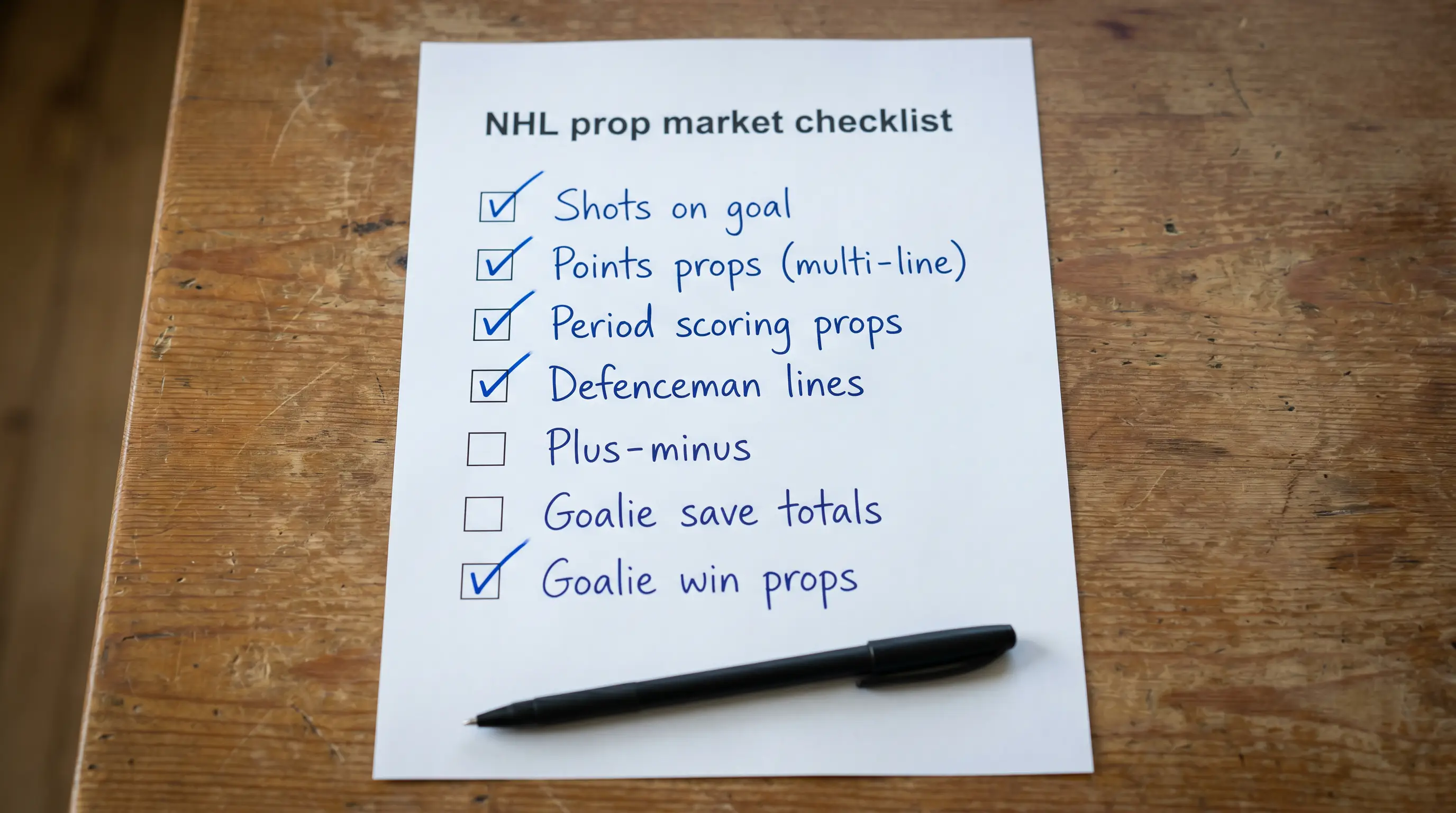
I covered the prop market in detail earlier in this content cluster, and the relevance here is simple — a UK book that publishes only anytime goal scorer and total goalie saves is offering a fraction of the prop universe a serious NHL bettor needs. The depth markers to look for are shots on goal, points props at multiple lines, period-specific scoring props, defenceman-specific lines, plus-minus props, and goaltender props beyond the standard save total. Five or six props per game isn’t depth. Fifteen to twenty per game, with multiple lines per market, is depth.
Stanley Cup and division futures
Futures coverage is the second tell of a serious NHL book. A book that opens Stanley Cup futures within a week of the previous Cup being lifted, prices Conn Smythe and individual award markets through the playoffs, and publishes division and conference winner odds for the upcoming season is engaging with the sport at the level a long-term NHL bettor needs. A book that opens Stanley Cup futures in September because they had to, and offers no other long-dated markets, is a different proposition entirely. The futures menu is a leading indicator of depth on every other NHL page in the same operator.
Same-game parlay availability
Same-game multis, bet builders, prop builders — the naming varies by operator but the product is the same. Every major UK bookmaker now offers NHL same-game parlays on at least the marquee games, and the better operators offer them on every game on the schedule with full prop-leg integration. The correlation pricing on same-game multis varies meaningfully between books, which means the same three-leg ticket can be priced at 8/1 at one operator and 11/1 at another. Comparing the price of a builder you’d actually bet across two or three UK books is one of the fastest ways to evaluate operator quality.
How the Money Actually Moves In and Out
The payment side of UK NHL betting is more regulated than most punters realise, and the rules have changed materially in the last six years. A bookmaker can have brilliant NHL markets and a strong live product, but if their payment processing is slow or their withdrawal limits are punitive, the operational experience falls apart. UK regulation is strict enough that most licensed operators offer broadly similar payment options. The differences are in the speed and the limits.
Debit cards and bank transfers
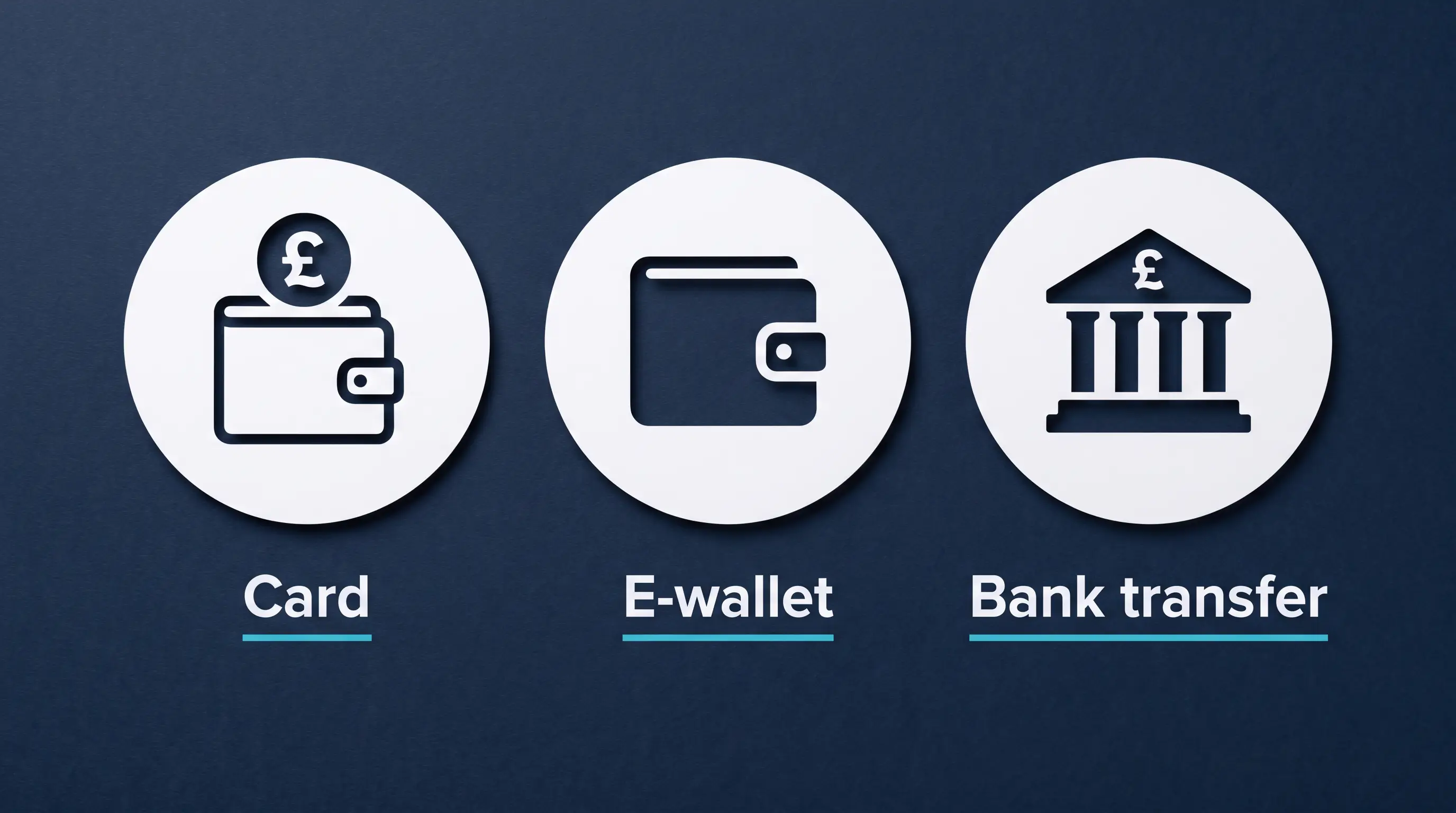
UK debit cards remain the most common deposit method at licensed bookmakers — most operators support Visa, Mastercard and Maestro for instant deposit, with no fees on the bettor’s side. Bank transfers via Faster Payments process within two hours for deposits. Withdrawal back to a debit card now clears within a few hours at the strongest operators, where five years ago the same withdrawal would have taken three working days. The improvement is the result of UKGC pressure on operators to reduce withdrawal friction, and the difference between books that have invested in the upgrade and books that haven’t is visible the first time you try to cash out a winning NHL ticket.
E-wallets — PayPal, Skrill, Neteller
PayPal is the most-used e-wallet at UK licensed operators, supported by virtually all the major bookmakers including bet365, William Hill, Ladbrokes and Paddy Power. Skrill and Neteller are the next tier. The advantage of e-wallets over cards is withdrawal speed — funds typically land within thirty minutes at the strongest UK books, compared with two to twenty-four hours on a debit-card withdrawal. The disadvantage is that some welcome bonuses exclude deposits made via e-wallet, which is worth checking before you set up the account.
Why credit cards are banned for UK gambling
Since April 2020, credit-card deposits to UK gambling operators have been completely prohibited under UKGC rules. The ban applies to all forms of gambling — sports betting, casino, bingo, lottery products — and to every UK-licensed operator regardless of size. The reasoning was straightforward: gambling with borrowed money correlates strongly with problem gambling indicators, and the cleanest intervention was to remove the option entirely. Any UK NHL bettor who tries to deposit with a credit card will have the transaction declined, and any operator that accepts a credit-card deposit is, by definition, not UKGC-licensed.
Withdrawal timelines
Withdrawal timelines are the single best test of an NHL bookmaker because they reveal the operator’s underlying approach to customer service. The strongest UK books pay e-wallet withdrawals in under two hours, debit-card withdrawals within twenty-four hours, and bank transfers within one to two business days. Anything slower than that on a non-disputed withdrawal is a red flag — operators who friction their withdrawals tend to friction their customer service in matching ways.
Reading the Promotion Page Without Getting Played
The bonuses page on every UK sportsbook is the part marketing has worked hardest on, and it’s the part where new bettors most often lose orientation. A welcome offer headline of “Bet £10, get £30 in free bets” reads like obvious value. Whether it actually is value depends on a set of mechanics that the marketing copy carefully buries — wagering requirements, minimum odds, qualifying market restrictions, time limits, withdrawal conditions. The same nominal bonus can be excellent value at one operator and effectively unredeemable at another.
How UK bookmaker bonuses are regulated
UKGC rules require licensed operators to display all material terms of a bonus clearly, in plain language, before the customer opts in. The Commission has fined operators in the last three years for terms that were judged misleading — wagering requirements buried in linked PDFs, expiry clauses that wiped bonuses after seventy-two hours. The rules are stricter now, and the visible terms on the promotion page are usually accurate. What changes between operators is the substance of those terms, not whether they’re disclosed.
Reading the wagering requirements
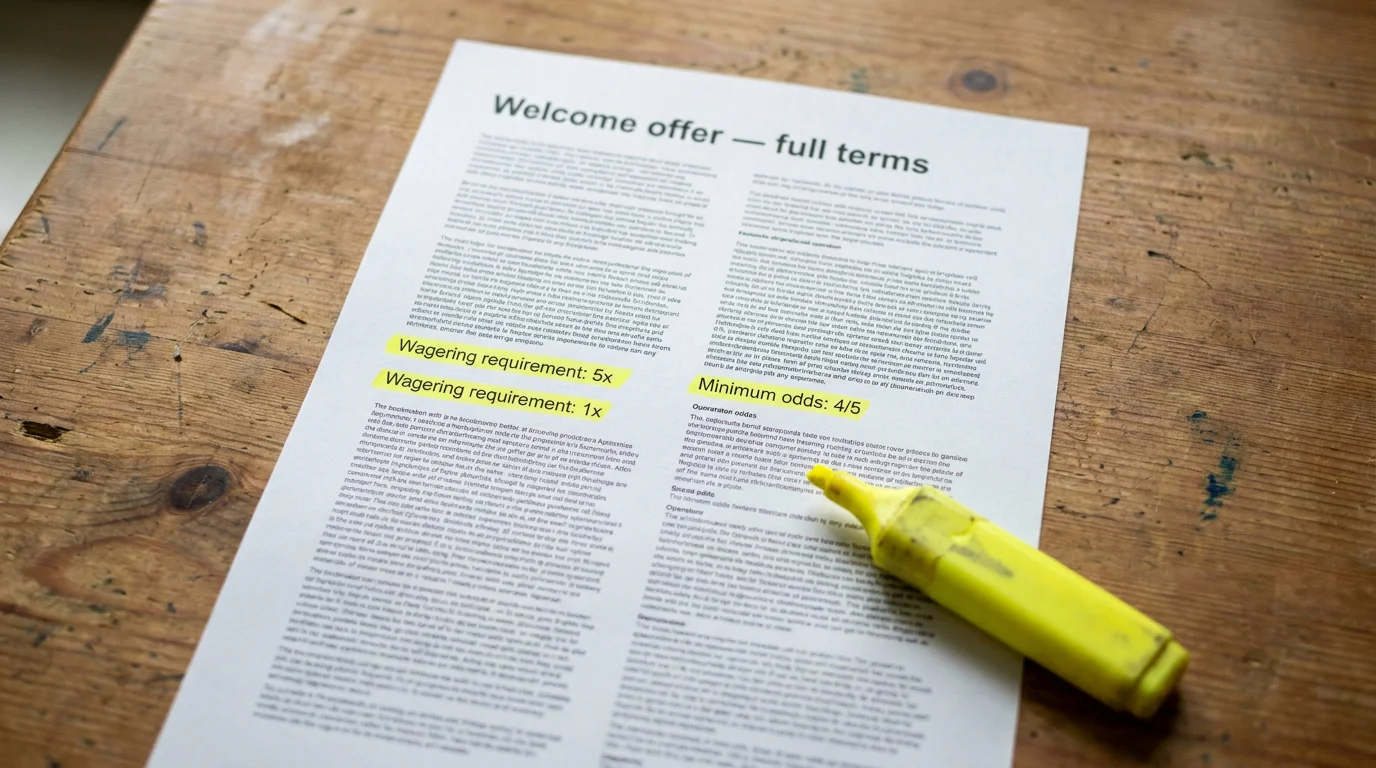
A wagering requirement is the multiple of the bonus value that must be bet through the account before the bonus or its winnings can be withdrawn. A “10x wagering” requirement on a £30 bonus means £300 must be staked before withdrawal. Wagering on UK sports-betting welcome offers typically runs from 1x to 8x, with most major bookmakers landing around 2x to 5x. Casino-style wagering requirements of 30x to 50x do not apply to sportsbook bonuses at UK-licensed operators — if you see a 30x wagering on what’s marketed as a sports welcome offer, the bonus is either casino-only or the operator is misrepresenting the product.
Profit boost vs free bet vs deposit match
The three main bonus types each behave differently. A free bet returns winnings minus the stake if the bet lands — a £10 free bet at 3/1 returns £30 in cashable funds, not £40. A deposit match credits an equivalent bonus subject to wagering — a 100 percent match on a £50 deposit gives you £50 in bonus funds that must be wagered before withdrawal. A profit boost increases the return on a winning bet by a fixed percentage — a 25 percent profit boost on a £20 winning bet at 2/1 adds £10 to the standard £40 profit. Each format has a different effective value depending on the wagering structure attached. The discipline is to convert every offered bonus into its effective cashable value before you opt in.
The Phone Lines Open at Two in the Morning
I had a settlement dispute at twenty past two on a Tuesday morning last February, on a bet builder that had been graded as a loss when one of the legs should have settled as a win. The operator’s live chat opened the queue with a three-minute wait. The chat agent had me through to the NHL settlement desk inside seven minutes. The dispute was resolved and the bet regraded inside fifteen. That experience is the gold standard for NHL customer support, and it’s not the experience every UK book offers.
24/7 support for late-night NHL bets
Live chat or telephone support that runs through the full NHL window is the operational baseline for serious hockey betting. Games end at 2 am UK time, settlement queries arise within minutes, and the operator’s ability to staff that window determines whether disputes get resolved the same night or pushed to a queue the next afternoon. The strongest UK NHL books run live chat 24/7 with NHL-trained settlement specialists on the overnight shift. Mid-tier operators run live chat through to 1 or 2 am and pause until the morning. Operators with UK office-hours support only are structurally unsuited for NHL betting regardless of how their product looks on paper.

Bet settlement disputes
Disputes happen. Even at the most professional UK books, occasional grading errors slip through — a same-game multi where one leg is incorrectly settled, a player prop voided on a scratch that wasn’t actually a scratch, an overtime settlement that wasn’t applied. The handling of these disputes is the test of customer service. The strong operators regrade on the spot if the evidence is clear, escalate to a settlement manager if it isn’t, and follow up within 24 hours with a written outcome. The weaker operators stall, request unnecessary documentation, and let the queue absorb the complaint until the customer gives up.
UKGC ADR and Alternative Dispute Resolution
Every UKGC-licensed operator must be signed up to an Alternative Dispute Resolution provider — an independent body that handles complaints that can’t be resolved between the customer and the bookmaker. The ADR process is free for the customer, binding on the operator, and typically resolves within four to eight weeks. The existence of the ADR backstop is part of what the UKGC licence buys you, and it’s the reason a £900 dispute at a UK-licensed book has a path to resolution that a £900 dispute at an offshore operator does not. Most bettors will never need to escalate. The existence of the escalation route is what ensures the operator handles the dispute properly long before it reaches that stage.
The Signals That Should Make You Close the Tab
Some red flags are obvious. Some are subtle, and the subtle ones are the ones that catch bettors out months into a relationship with an operator. I’ve maintained accounts at twelve different UK-licensed bookmakers over the years and closed three of them after spotting one of the patterns below. The pattern matters more than any individual incident — a single slow withdrawal is irritating but not disqualifying. A pattern of slow withdrawals combined with friction on basic queries is the operator telling you, quietly, that they don’t intend to be a long-term partner.
No UKGC licence
The non-negotiable red flag. Any site marketed at UK bettors that doesn’t display a current UKGC licence number is operating outside the regulated market regardless of what other licences they hold. Curacao licences, Isle of Man licences, Gibraltar licences — none of them are equivalent to UKGC authorisation for UK consumer protection. The site might process your deposit and pay out small withdrawals while building trust. The risk is concentrated on the larger withdrawal that follows a winning NHL playoff run, and the absence of recourse when something goes wrong with it.
Hidden FVC enforcement
The financial vulnerability check threshold for UK online gambling was lowered from £500 to £150 per thirty-day window on 28 February 2025. The FVC is a soft check the operator runs against publicly available financial data — county court judgments, bankruptcies — to identify customers who might be gambling at unaffordable levels. The check is intentionally low-friction; for most bettors it runs invisibly in the background. What you should not be experiencing is an operator that performs FVCs at a much lower threshold than the regulation specifies, demands extensive personal documentation for a £50 deposit, or freezes your account pending a financial review you didn’t trigger. For the complete walk-through of the FVC threshold and how the check actually runs across UK NHL betting accounts, my FVC threshold breakdown covers what the soft check looks at and what should and shouldn’t trigger it.
Withdrawal slow-rolls and account limits
The most subtle red flag is the withdrawal slow-roll — an operator that pays small withdrawals promptly but introduces friction on larger ones, often after a winning NHL run. The friction usually takes the form of documentation requests that should have been completed at account opening, manual review queues that take three to five business days, or staking-limit changes that quietly reduce your maximum bet on the markets where you’ve been profitable. None of these individually is necessarily improper. The pattern, applied selectively to winning bettors, is the operator signalling that they don’t want your business. The honest response is to withdraw what they’ll release and close the account.
The Checklist I Run Before I Open Any NHL Account
The framework I’ve walked through collapses into a short personal checklist I run before I open any UK NHL betting account, in this order. UKGC licence number verified against the public register. NHL market depth checked against a midweek slate — at least fifteen props per marquee game and three-way moneylines on every match. Live betting product tested on a real game, watching the price update cadence during a power play and an in-overtime moment. Withdrawal timeline confirmed by reading the operator’s banking terms, not the marketing copy. Customer support hours confirmed to cover the full NHL window through to 3 am UK time.
Beyond the checklist, the operational test is the first month. A UK NHL bookmaker that handles a settlement query at 2 am politely and accurately is a bookmaker worth keeping. One that ducks the same query, slow-rolls the response, or escalates it to a queue you can’t reach again is telling you what the long-term experience will look like. The regulated UK sector has 22.5 million monthly customers, and the operators competing for them have every incentive to do the job well. The ones that don’t are the ones you find out about by depositing with them. The criteria here are what let you avoid that.
How do I confirm a sportsbook holds a UKGC licence?
Every UK-licensed operator must display its UKGC licence number on the footer of its website. To verify the licence, copy the number and paste it into the Gambling Commission’s public licence register, which is freely searchable on the Commission’s official site. The register confirms the company name behind the licence, the activities the licence covers, and whether the licence is currently active. The verification takes under two minutes. If a site doesn’t display a UKGC licence number, or the number isn’t found on the register, the operator is not UKGC-licensed regardless of any other claim made in its marketing copy.
Why are credit cards banned for UK gambling deposits since April 2020?
The UK Gambling Commission prohibited credit-card deposits to all UK-licensed gambling operators from 14 April 2020, on the basis that gambling with borrowed money correlated strongly with problem-gambling behaviours. The ban applies across sports betting, casino, bingo and lottery products. Debit cards, bank transfers and approved e-wallets remain available. Any operator that accepts a credit-card deposit from a UK customer is operating outside UKGC rules and is by definition not UK-licensed.
Are NHL welcome bonuses worth the wagering requirements?
It depends on the structure. UK sports welcome bonuses typically carry wagering requirements between 1x and 8x the bonus value, which is dramatically softer than casino wagering. A ‘Bet £10 get £30 free bets’ offer with 1x wagering and minimum odds of evens is usually positive expected value for an active NHL bettor who would have placed similar bets anyway. The same nominal offer with 5x wagering, minimum odds of 4/5 and a seven-day expiry can be effectively unredeemable. Always convert the offer to its cashable equivalent before opting in.
Can I legally use a non-UK-licensed sportsbook while living in Britain?
There is no criminal offence for a UK resident who places a bet at an unlicensed offshore sportsbook, but the consumer protections that apply at UKGC-licensed operators — fund segregation, dispute resolution, advertising standards, responsible gambling enforcement — do not apply. The practical risk is concentrated on withdrawals: an offshore operator that takes your deposit has no UK legal obligation to honour a winning withdrawal, and you have no UK regulatory body to escalate a dispute to. The legal grey area is real, but the protective gap makes it a poor trade-off for any meaningful stake.
