
 Available in US
Content

The first NHL same game parlay I ever cashed was a four-leg ticket on a Tuesday Vegas game in my third season of betting hockey — Vegas moneyline, over 5.5, anytime goal scorer on Mark Stone, and shots over 2.5 on Jack Eichel. Returned 11/1 from a £10 stake. I was thrilled until I realised I had simply been right four times about the same thing: Vegas was going to score a lot. The legs were not four bets. They were one bet, with the book charging me less than the maths said it should have.
An NHL same game parlay, or SGP, is a single ticket combining two or more legs from a single match — moneyline, total, period results, props — into one bet that pays only if every leg hits. The crucial difference from a traditional parlay is that the legs come from the same game, which means the bookmaker accepts and prices in the fact that the outcomes will correlate. A standard parlay assumes independent events. An SGP assumes nothing of the sort, and the price you see on screen reflects that adjusted maths.
SGPs sit inside the broader sports betting market, which is forecast to reach roughly $119 billion in global handle in 2025 and continues to grow at single-digit annual rates. UK sportsbooks have been pushing SGP builders aggressively because they generate larger ticket sizes than singles and longer holds on average. That’s the product reality. The strategic reality, which I’ll spend the rest of this piece on, is that correlation cuts both ways — and a punter who reads it correctly turns a marketing product into a value market.
How an NHL same game parlay differs from a normal parlay
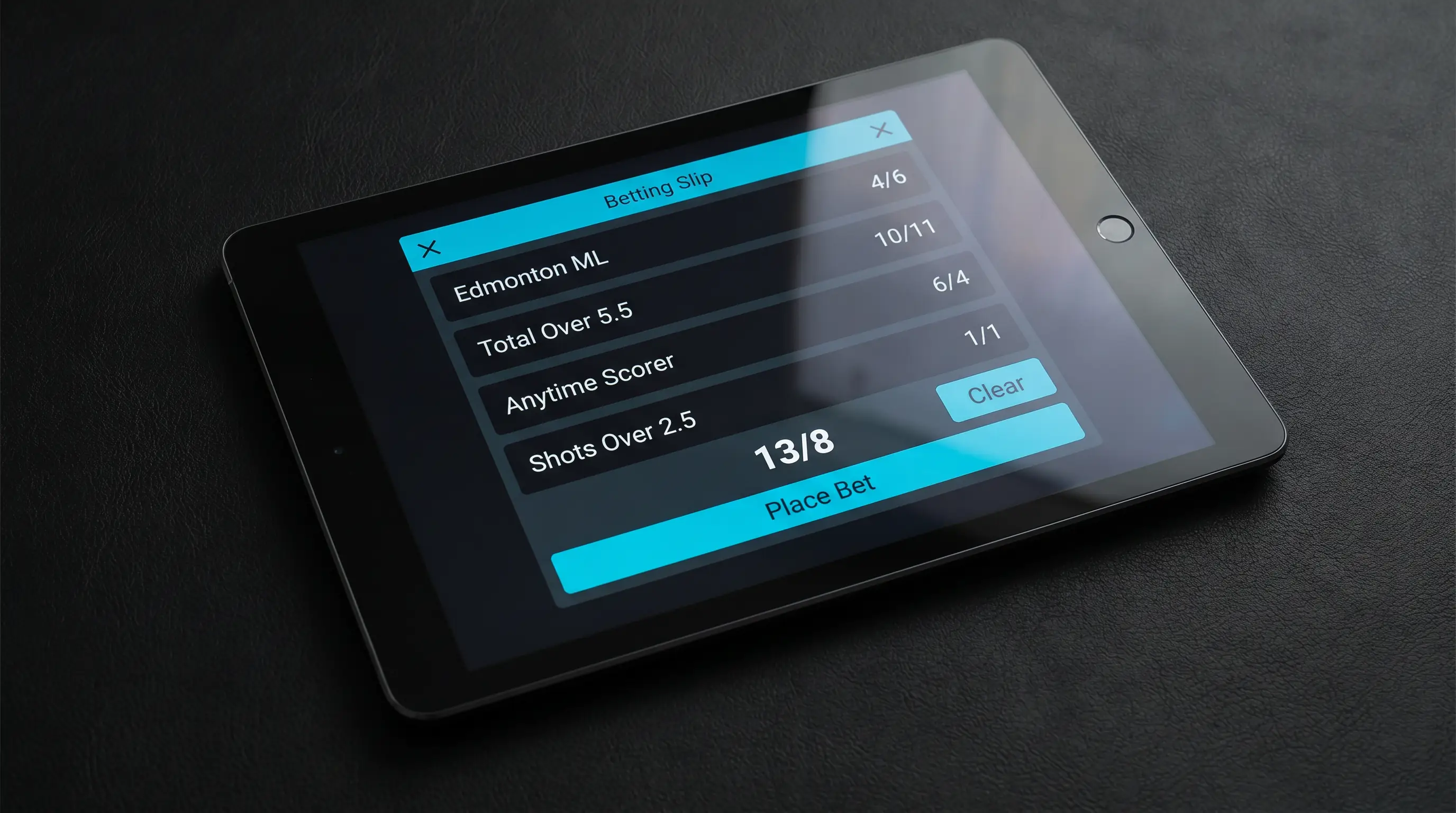
Take two simple legs: Edmonton moneyline at 4/6, and over 5.5 in the same game at 10/11. If you parlayed those independently, the maths would be straightforward — multiply the decimal odds (1.67 × 1.91 = 3.19) and the ticket prices at 2.19/1 fractional. UK books would never let you do that on a same-game ticket, though, and for a very good reason.
Edmonton winning makes over 5.5 more likely. Edmonton scores. Over 5.5 needs goals. The two outcomes are correlated, so the true joint probability is higher than the independent multiplication suggests, which means the fair price is shorter than 2.19/1. The book runs a correlation adjustment and offers you the SGP at something nearer to 13/8 — still above the singles, but considerably below the naive parlay maths.
Settlement follows standard NHL parlay rules. Every leg must hit. If a single leg pushes — for example, the total comes in at exactly 5 when you took 5 flat as one of three legs — that leg drops out and the ticket recalculates at the remaining odds. Most UK operators apply this rule consistently across their SGP builders, though I always check the specific T and Cs because operator wording varies on what happens when a player leg voids due to a healthy scratch versus an in-game injury.
The bookmaker’s margin on an SGP runs noticeably higher than on a comparable single, often 8–12% versus 4–5%. That’s the cost of access to the product. A punter who builds blindly is paying that surcharge for the privilege of stacking legs into one ticket. A punter who builds carefully captures correlation the book has under-modelled, which is the only sustainable angle on this market.
Which legs actually correlate, and which don’t
Positive correlation is what you want. It’s what makes an SGP a real bet rather than a glorified accumulator. The cleanest positive correlations on an NHL ticket involve a team and its own scoring outputs: Team A moneyline plus Team A team total over plus an anytime goal scorer on Team A’s top line. All three legs share the same dependent variable — Team A scoring goals — which means hitting one nudges you towards hitting the others.
The dirtier correlations are the ones that look positive but reverse on close inspection. Take Team A moneyline plus over 5.5 plus shots on goal over for Team A’s first-line winger. That looks correlated, but high-pace games where Team A wins comfortably often see fewer shots on Team A’s top forwards because the coach rests them in the third period. Counter-intuitive, but it’s a pattern that has cost me money more than once.

Negative correlations are the trap. A Team A moneyline plus Team A goalie shots-against-faced over 30 looks like a “Team A wins but it’s an entertaining game” bet, when in reality strong Team A wins usually mean Team A controls the play and faces fewer shots. The two legs work against each other inside the ticket maths, and most UK SGP builders will let you place this combination — they just won’t apply the correlation adjustment, because for them the legs run independent in the simplified model. You get the worst of both worlds: a parlay that pays too little and conflicts with itself.
Period-based legs are where I find the most consistent value. Combining a first-period under with a full-game over, for example, captures the common NHL pattern of late-game empty-netters and third-period score-effect goals. The first-period under hits roughly 56% of the time on slow-start matchups; the full-game over comes home when the late stanza opens up. The two legs aren’t fighting each other.
What UK sportsbooks offer on their SGP builders
Most UKGC-licensed operators now run SGP products on NHL matches, with the builders typically opening 24 to 48 hours before puck drop. The available markets cover moneyline, puck line, period results, team totals, anytime scorer, first scorer, shots on goal, saves, and a handful of operator-specific exotic props. Coverage varies. Some books offer eight buildable markets per game; others offer twenty.

UK SGP builders share two technical limitations worth knowing. First, you cannot combine certain legs that are explicitly correlated within the operator’s internal rules — Team A moneyline plus Team A puck line plus Team A team total over, for instance, will usually be flagged and the builder will reject one leg. Second, the maximum payout cap on SGPs is often lower than on standard parlays, sometimes by an order of magnitude. Books are cautious about correlated exposure precisely because a heavy SGP run can wreck a daily book — and traders openly discuss managing that exposure. After Game 1 of the 2026 Stanley Cup Final, when Vegas Golden Knights beat Carolina, the BetMGM trading manager Christian Cipollini put it bluntly: at this point we’re hoping Carolina can get it done. That kind of comment from the trading desk is rare; it tells you everything about how seriously books take their correlated-product liability, and why SGP terms tighten as your stake size grows.
Price comparison across UK SGP products is harder than for singles because every builder applies its own correlation engine. A four-leg SGP on the same match can come back at 8/1 on one operator and 11/1 on another, and the difference isn’t always who has the loosest singles. It’s who has the tightest correlation model. That makes shopping the same SGP across multiple operators essential, which is exactly why I treat a multi-account approach to NHL line shopping as the foundation of any SGP strategy rather than a separate skill.
When SGPs are worth building and when they’re a trap
I build SGPs when three conditions converge: I have a strong opinion on the game’s overall direction, the legs I want to combine are positively correlated, and the builder’s quoted price exceeds my own correlation-adjusted estimate. If any of those is missing, I bet singles.
The strong opinion is non-negotiable. A two-leg SGP needs both legs to win, which means even a 60% leg paired with a 60% leg comes home only 36% of the time if the legs run independent. With positive correlation, the joint probability climbs — but you’re still asking two propositions to be right simultaneously. Without conviction, you’re stacking variance for variance’s sake, and variance compounds faster than skill.

The correlation has to be real. I keep a small notebook of legs that the data tells me correlate at 0.4 or above — team moneyline with team total over on home favourites, first-period over with full-game over on top-pace matchups, goalie saves over with opponent shots over on busy nights. Those are the building blocks. Anything outside that notebook, I treat as independent for my own pricing, which usually means the SGP price doesn’t beat my model and I pass.
The price test matters most. I run a quick estimate: independent multiplied odds divided by my own correlation factor. If the book’s SGP price is shorter than my estimate, I’m overpaying. If it’s longer, the book has under-priced the correlation, and that’s the bet. Across nine NHL seasons, the rate at which builders under-price has been low but consistent — maybe one in five attempted SGPs makes it to a placed ticket. The rest go in the bin, which is exactly where they belong.
Reading SGPs as a working product, not a flutter
An NHL same game parlay is a structured trade against the operator’s correlation model, not a flutter on a busy night. The maths only works when you have an opinion, the legs share a dependent variable, and the quoted price beats your own correlation-adjusted estimate. Get any one of those wrong and you’re paying a hidden surcharge for the convenience of stacking. Get all three right — across a long season of 1,312 matches with hundreds of SGP-eligible builders running daily — and the product becomes a slow, profitable side market rather than a noisy one-off. The builders are not your enemy. They are a tool that occasionally mis-models the correlation strongly enough to give a careful punter a real edge, and the discipline to walk away from the other four out of five is what determines whether that edge ever shows up in your bankroll.

How does the price differ between an NHL same game parlay and a standard parlay?
A standard parlay assumes independent legs and multiplies the individual odds directly. An SGP adjusts for correlation between legs from the same match — typically shortening the price by 20–40% compared with the independent multiplication. The exact reduction depends on the operator’s correlation engine and the specific combination of legs.
Which NHL legs correlate best inside a same game parlay?
The strongest positive correlations come from stacking a team’s moneyline with that team’s total over and an anytime goal scorer from that team’s top line. First-period and full-game totals also correlate well when both lean the same direction. Avoid combining a team’s moneyline with its goalie’s high-shots-faced market, since strong wins typically suppress opposition shot volume.
Why do UK bookmakers reject certain correlated NHL leg combinations?
UK operators apply internal rules that block legs they consider too correlated to price safely, such as a team’s moneyline combined with that team’s puck line and team total over. The builder will flag and reject one of the legs. This protects the book from underpricing extreme correlation and is consistent across most UKGC-licensed SGP products.
