
 Available in US
Content
- How a UK Bookmaker Builds the Puck Line
- Favourite vs Underdog on the Puck Line
- The Puck Line Trends That Bank Money for UK Bettors
- Reading the Puck Line on a UK Sportsbook
- When the Puck Line Pays and When It Doesn't
- Where Punters Lose Money on the Puck Line
- Four Numbers I Default To on Every Puck Line Bet

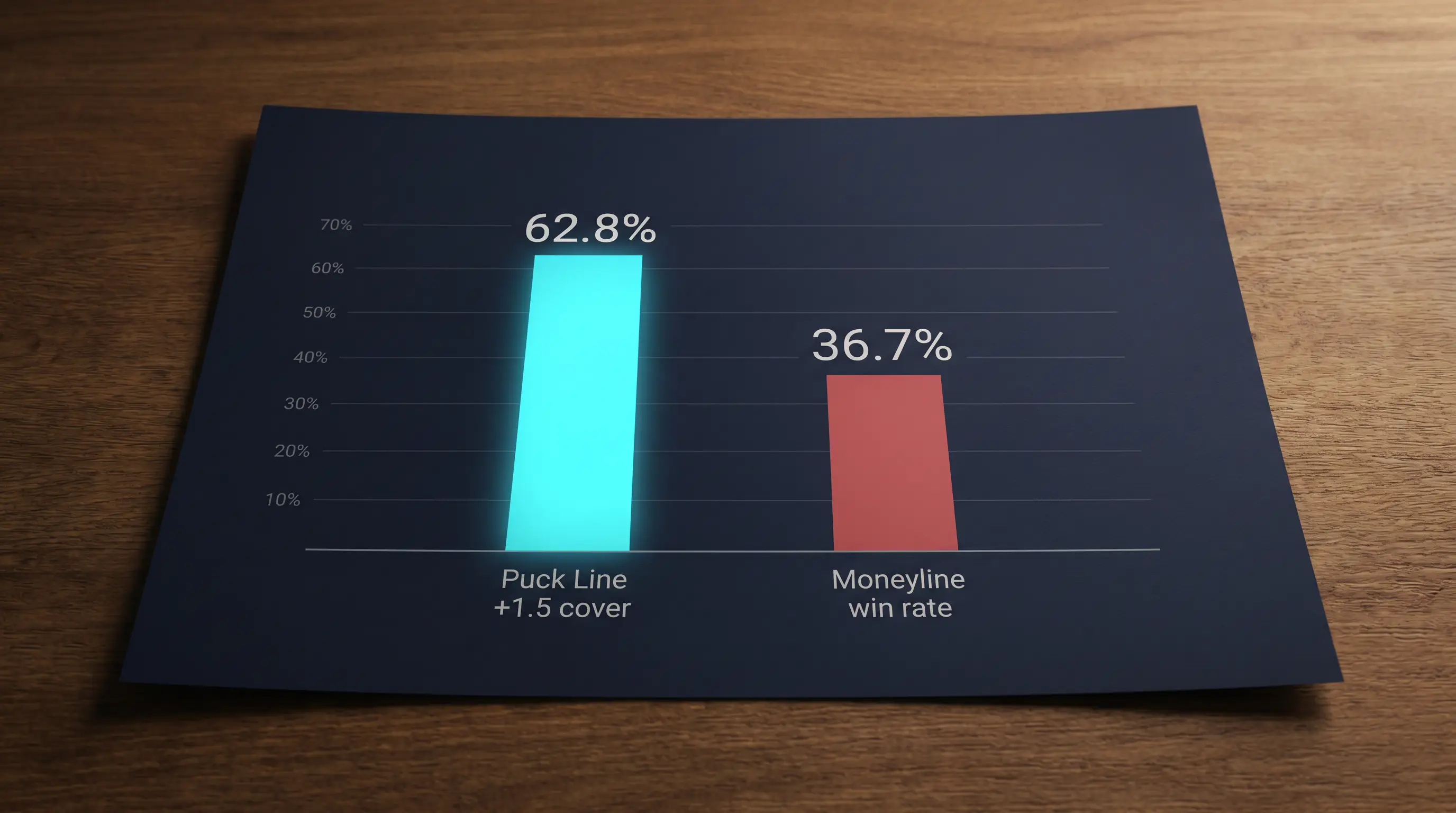
The NHL puck line is hockey’s fixed 1.5-goal spread, and it’s the only major North American sports market where the bookmaker leaves the line alone and moves the price instead. Underdogs at +1.5 cover that spread 62.8 percent of the time across the historical NHL data — against a moneyline win rate closer to 36.7 percent for those same teams. That 26-point gap is the entire reason this market exists in its current form, and it’s the reason this guide does too.
I learned that gap the slow way. Nine years ago I started keeping a spreadsheet of every NHL puck line bet I made, mostly tracked from a flat in north London at two in the morning while the rest of the country slept. The first thing the data taught me was that I’d been wrong about underdogs. I was losing on the moneyline night after night. Once I shifted the same selections to +1.5 on the puck line, the spreadsheet turned green within a couple of months and stayed that way.
For a UK punter coming from football accumulators or horse racing, the structure feels backwards at first. You’re conditioned to see -0.5 on Brentford versus Manchester City and -2.5 on Newcastle against a relegation side — handicaps that adjust to the matchup. Hockey doesn’t work that way. You get a fixed -1.5 on the favourite and +1.5 on the dog on virtually every game on the NHL slate. The book only moves the price. If a team sits at -300 on the moneyline, the -1.5 puck line might price near -120. If the same team is closer to a coin flip, that -1.5 number could jump to +170 or higher.
The market is built on a tight, low-scoring sport where home-ice advantage averages about 0.28 goals per game and roughly one game in four ends in overtime or a shootout. Those two facts shape every puck line price you’ll read. In this guide I’ll walk you through the mechanics, the historical trends with hard numbers, a worked example at UK fractional prices, and the matchup spots where the puck line earns its keep against the moneyline — plus the ones where I leave it well alone.
How a UK Bookmaker Builds the Puck Line
Picture the Edmonton-Florida final from last June. Edmonton is a moneyline favourite in Game 4 at home — say -160 in American terms, 4/6 on a UK card. Open three UKGC-licensed books and check the puck line. Each one shows -1.5 on Edmonton. Not -1. Not -2. Not -1.5 on one site and -2 on another. The line is identical across the market. What changes between books is the price next to that -1.5, and that price is the only thing the bookmaker actually controls.
This is the foundational mechanic that catches out football punters. You’re used to handicaps that adjust to the matchup. Hockey doesn’t.
Why 1.5 Is the Standard Spread
Average NHL goals per game sit in the 5.5 to 6.5 range, depending on the season. The home team typically wins by about 0.28 goals once you control for skill — small, but consistent across decades of data. A two-goal spread would price the underdog out of the market completely. A half-goal spread would behave like the moneyline with extra steps. 1.5 sits in the sweet spot. It’s wider than the average regulation winning margin but small enough that a single empty-net goal at 19:30 of the third can flip the result. That tension is what gives the puck line its volume.
Some UK punters ask why bookmakers don’t offer -2 or -2.5 on big favourites, the way American football does with point spreads. They do — alternative puck lines are a separate market with their own dynamics — but the standard product remains anchored at 1.5. The whole NHL board is built around that number.
How the Price Moves While the Line Stays Put
Take a Pittsburgh-Buffalo matchup. Pittsburgh is -250 on the moneyline — heavy chalk. The -1.5 puck line on Pittsburgh might land around -125. That’s the price you pay for the 1.5-goal cushion when the moneyline already screams heavy favourite.
Now imagine the same Pittsburgh against a near-coin-flip opponent like Carolina. Same Pittsburgh, but the moneyline reads -130. The -1.5 puck line jumps to roughly +150. Same team, same buffer, but the price has flipped from negative to positive because the implied probability of Pittsburgh winning by two or more has collapsed.
The book doesn’t change the spread. It changes how much it costs you to take that spread. Once that clicks, the whole market makes sense.

UK Fractional vs American Notation
This is where UK punters need to keep two columns in their head. American books advertise puck lines as -1.5 at -125 or +1.5 at +105. UK books usually convert that into fractional: 4/5 instead of -125, 21/20 instead of +105. Same price, different presentation. A few UK sportsbooks let you toggle the display to decimal — 1.80 in that first example — which is also how prices appear on Betfair Exchange and Smarkets.
When I’m line-shopping I keep all three formats open on different tabs. If one shop offers 4/5 on Pittsburgh -1.5 and another shows 5/6 on the same bet, I’m taking the 4/5 every time. It’s the same wager, but 4/5 pays £16 net on a £20 stake compared to £16.67 at 5/6 — wait, that one’s a wash. The point holds at slightly bigger gaps: 4/5 versus 8/11, or 11/10 versus 21/20. Tiny edges repeat across a 1,312-game regular season, and they’re the whole margin between a profitable hockey punter and a losing one.
Favourite vs Underdog on the Puck Line
Two bets, same teams, opposite sides — and historically they don’t pay the same. Take Tampa Bay hosting Buffalo. Backing Tampa -1.5 means you need them to win by two or more in regulation, overtime or shootout. Backing Buffalo +1.5 means Buffalo can win outright, lose by one, lose in overtime, or lose in a shootout. Four ways to cover versus one way to lose, against one way to cover versus four ways to lose. The mathematics is brutal, and it’s why the puck line price differs so sharply between the two sides.
Backing the -1.5 Favourite
Backing -1.5 is a bet on dominance. You need your team to win by two goals or more, and overtime and shootout goals only count as one in settlement — which is the catch I’ll come back to. The attraction is the price. A Boston team that reads -250 on the moneyline might offer you -1.5 at -110 or -120, giving you near-even money on the same underlying outcome (Boston wins) plus a margin requirement.
For UK punters this is the puck line spot most worth scrutinising. The implied probability of Boston winning by two or more goals isn’t close to the implied probability of Boston simply winning. NHL games end in overtime or shootouts about 23.9 percent of the time, which means in roughly one in four games where the favourite wins, they do so by a single goal. Backing -1.5 in those four-in-five regulation-decided games is a real edge — but only if you’ve correctly identified the matchups where the dog can’t keep it within 90 seconds in the third period.
Backing the +1.5 Underdog
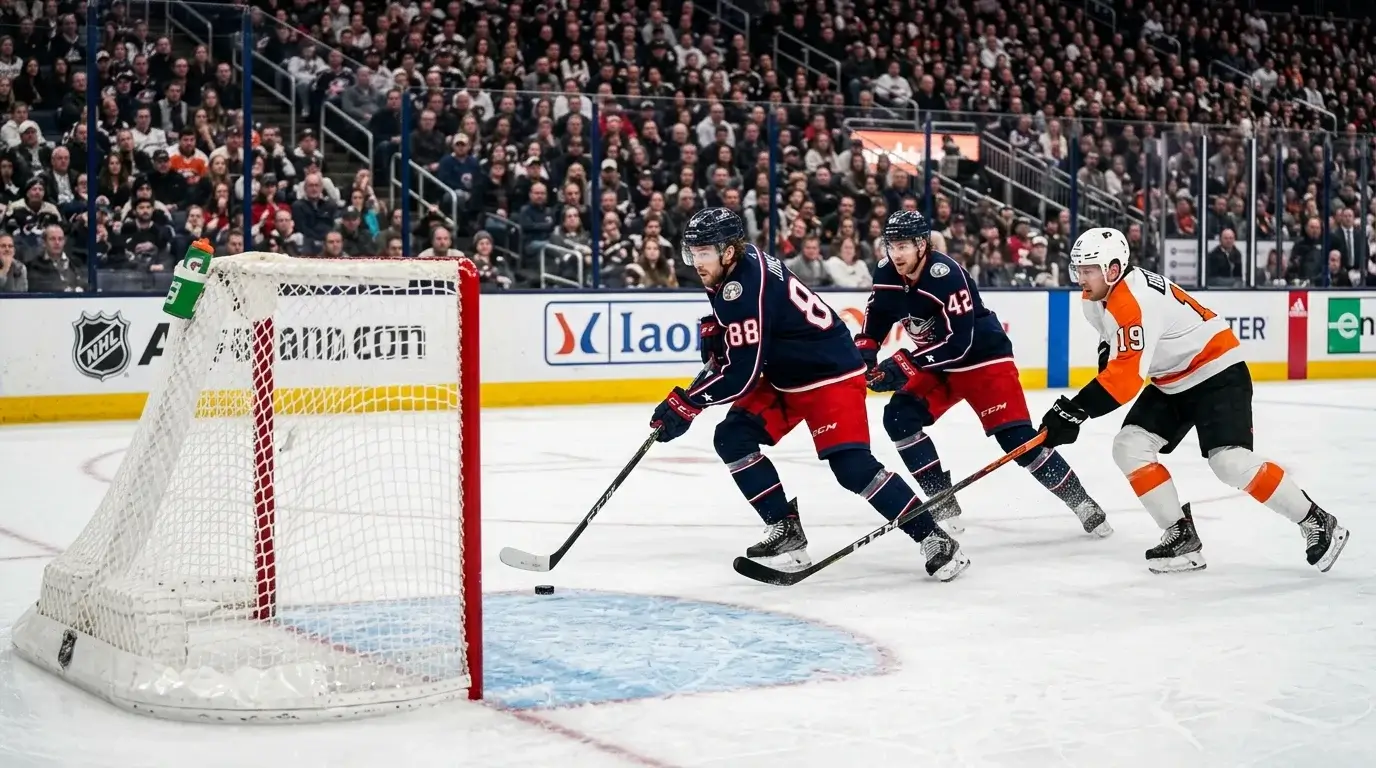
Backing the +1.5 underdog is the bet I run most often. Home dogs at +1.5 cover 63.9 percent of the time across the recent NHL data set, and as a UK punter, you can find these games every single night between October and April. The mechanism is intuitive: hockey is a tight, low-scoring sport, third-period empty-netters are common, and the trailing team pulls its goalie when down by one. The empty-net goal pushes 1-0 finals to 2-0, breaking the +1.5 cover.
Strip those empty-netters and the underdog is in the game more often than the moneyline suggests. A team losing 2-1 with five minutes left is, on average, going to lose 3-1 once the empty-net goal lands — and that 3-1 result still pays +1.5 dogs. So the historical 62.8 percent +1.5 cover rate isn’t blind luck. It’s the structural result of how hockey games actually end.
When Push Results Occur
The standard puck line at 1.5 cannot push. That’s the entire reason the number is 1.5 rather than 1 — a flat-line -1 spread would push every time the favourite won by exactly one goal. The half-goal hook on either side ensures every bet has a winner. Some UK books offer alternative puck lines at -2 or -2.5 where pushes can apply if the result lands on the integer margin, and a push refunds your stake. But on the standard product, no settled NHL game can refund.
The flip side is that on the 23.9 percent of nights where the game goes to overtime or shootout, the +1.5 dog automatically covers because OT and shootout goals are worth one goal in settlement. That’s an underrated edge for +1.5 backers and a structural ceiling for -1.5 takers.
The Puck Line Trends That Bank Money for UK Bettors
Sixty-two point eight percent. Bookmark that number. It’s the rate at which +1.5 underdogs cover the puck line across the modern NHL data set. Compare it to the same dogs’ moneyline win rate — 36.7 percent — and you’ve got a 26-point gap that explains why sharp UK bettors live on the puck line for selected matchups rather than the straight win line. The catch, and there’s always a catch, is that a 62.8 percent cover rate doesn’t equal a 62.8 percent profit rate. The price you pay for that +1.5 cushion eats most of it.
The 62.8 Percent Cover Rate in Practice
Run the maths. If +1.5 dogs cover 62.8 percent of the time and the average price you take is -130 (8/13 in fractional), your expected return per £100 staked is about £8.50 net of the bookmaker’s margin. That’s roughly a 4-5 percent return on turnover — small but real over a full season’s volume of 1,312 regulation games. The exact figure depends on which sub-sample you trust and how aggressive your selection is, but the headline pattern holds: +1.5 dogs are not random noise.
The reason I trust the 62.8 percent number, rather than treating it as a quirk, is that it’s reproducible across seasons and across data providers. Different services slice the figures differently — some include playoffs, some exclude them, some adjust for OT-shootout edge — but the headline +1.5 cover rate sits in the 60-64 percent band across most of the legitimate NHL betting archives I’ve worked with.
Home vs Away Splits on the Puck Line
Now split the data. Home dogs at +1.5 cover 63.9 percent of the time — the highest sub-rate inside the +1.5 universe. Road dogs at +1.5 still cover, just at a lower rate, closer to 60 percent. The home-ice premium averages about 0.28 goals per game, and that fraction of a goal is exactly what tips a meaningful number of home dogs from losing by two on the road to losing by one at home — or winning outright in front of their own crowd.
The home edge runs through the entire NHL data set. Home teams overall win the moneyline about 54 percent of the time. Home dogs specifically cover the puck line at 63.9 percent. That ten-point gap tells you the +1.5 buffer matters most when the home team isn’t expected to win outright — which is, again, the structural argument for the puck line in the first place.
That 63.9 percent home-dog ATS number is the single most reliable puck line angle I’ve tracked in nine years. If I had to give a UK beginner one line of strategy, it would be: home dogs at +1.5, with the goaltending matchup confirmed in your favour. Not every night. Not every home dog. But the ones where the home goalie is the better starter and the price holds at -130 or shorter are the closest thing to a bankroll play I know.
Why the Puck Line Outperforms the Moneyline by 26.1 Points
Back to the headline: 62.8 percent +1.5 cover versus 36.7 percent moneyline win rate is a 26.1-point gap. Part of it is the cost of the cushion — you pay for buying that buffer through worse odds. But not all of it. Once you adjust for price, you’re still left with a structural advantage on the underdog side that the moneyline can’t replicate.
When sharp analysts talk about value on a specific team, they’re often quietly talking about the puck line, not the moneyline. The Sportsbook Review desk, talking up the Vegas Golden Knights during this year’s deep playoff run, put it like this: “I think you have to be crazy to bet against the Vegas Golden Knights right now, and at +125, they’re as good a bet as any. They might just be the deepest team left, with the goaltending to back them up.” That’s a moneyline pick. The underlying logic, though — deep team, strong goaltending, value at the price — is exactly the framework you use to identify -1.5 favourite spots on a single-night card. Find that goaltending-plus-depth combination and the -1.5 price is usually softer than the moneyline equivalent.
Reading the Puck Line on a UK Sportsbook
Open any UK sportsbook on a Saturday night in February. NHL puck lines are usually buried two clicks deep, displayed in fractional, often with the spread number and the price stacked together in a way that takes a second to parse. If you’ve come from American sportsbooks where -1.5 at -125 is one clean line of text, the UK format demands some adjustment.
How Fractional Odds Compress the Puck Line View
UK books default to fractional, which is the format I learned to read on my father’s horse-racing slips long before I’d bet a single NHL game. Fractional is fine for football and horses, where the prices are usually neat — 2/1, 5/2, 7/4. Hockey puck lines often produce uglier fractions like 8/13, 11/10, 21/20, and those don’t scan as fast as -130 in American or 1.77 in decimal.
My workaround: I keep a small reference card on my desk and have done since the start. 4/5 equals -125. Evens, or 1/1, equals +100 or 2.00. 11/10 equals +110. 6/4 equals +150 or 2.50. 5/2 equals +250 or 3.50. Anything beyond 5/2 I convert in my head as fraction-plus-one for the decimal. Once you’ve internalised the conversions, the UK fractional display stops slowing you down.
Worked Example for a £20 Stake at 5/2
Say you’ve taken -1.5 on Toronto at 5/2 against Detroit at home. Stake: £20.
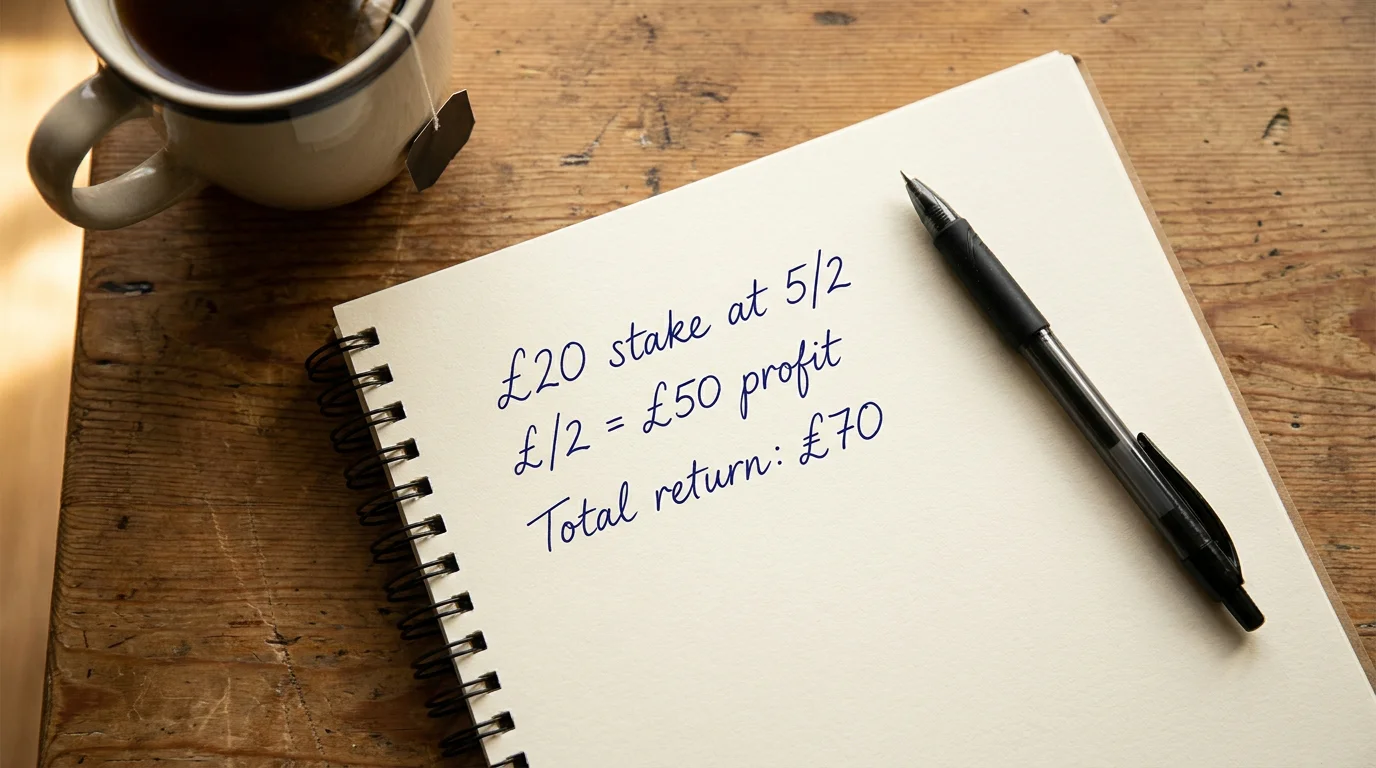
The fractional 5/2 pays £5 profit for every £2 staked. Your £20 stake at 5/2 returns £50 in profit plus the original £20, so £70 total. For comparison, 5/2 in decimal is 3.50, and £20 multiplied by 3.50 is also £70 total return. Same number, two formats.
If Toronto wins 4-1, you’ve covered comfortably and collect the full £70. If Toronto wins 3-2 in regulation, you’ve lost — they didn’t cover -1.5. If Toronto wins 3-2 in overtime or shootout, you’ve still lost — the OT goal counts as one goal in settlement rules, so Toronto’s margin is officially one. If Toronto wins 4-2 in regulation, you’ve covered.
5/2 is a generous price on a -1.5 favourite. Most -1.5 favourites you’ll see in the UK market price between 4/5 and 11/10 — evens to slightly odds-against. A 5/2 -1.5 favourite implies the bookmaker thinks the team will cover the spread roughly 28 percent of the time. If you’ve identified a matchup where you reckon the cover probability is 40 percent, that’s a positive expected value play even with the fractional juice baked in.
When the Puck Line Pays and When It Doesn’t
Not every NHL game is a puck line game. Some nights I scan a ten-game slate and bet two puck lines total. Other nights I bet six. The skill is knowing which is which, because the matchups where the puck line beats the moneyline aren’t random. They cluster around specific game profiles.
Heavy Moneyline Favourites and When -1.5 Unlocks Value
This is the cleanest puck line scenario. A team is -250 on the moneyline. That implies a 71.4 percent win probability and a payout of £40 for every £100 staked. Compare it to -1.5 at -120 on the same team. That implies the team wins by two or more roughly 55 percent of the time and pays £83 for every £100 staked. The maths flips when you account for the higher margin requirement, but in lopsided matchups, the -1.5 price is often softer than the moneyline.
Here’s what I look for. The favourite is at home, the underdog is on the second leg of a back-to-back, and the favourite’s starting goalie is confirmed. If those three boxes are ticked, taking the favourite at -1.5 at near-even money is one of the few NHL bets I’ll back to a meaningful stake.
Lopsided Matchups Where +1.5 Is a Buffer
The mirror image. You like the underdog. The moneyline pays +180 — tempting, but you’re not confident enough to back them outright. The +1.5 puck line on the same dog might be priced at -130 to -140, which converts your bet from ‘underdog wins’ to ‘underdog stays within one goal’ — a substantially easier outcome to hit. The price is worse, the bar is lower.
This is where the 63.9 percent home-dog +1.5 cover rate earns its keep. A home dog you like at +180 on the moneyline is also a home dog you should consider at -135 on the puck line. Plug your selection rules in, look at the rest situation, and the +1.5 buffer often gives you the better number once you adjust for the cover probability.
Avoiding the Puck Line on Toss-Up Games
Where the puck line becomes a tax instead of an edge is in the coin-flip games. Two evenly matched teams, both at home a lot recently, both with starters in net, both priced around -110 to -120 on the moneyline. The -1.5 price in that scenario typically reads +160 or +180, and the +1.5 price drops to -240 or worse.
Neither side of the puck line in a coin-flip game offers what I’d call value. You’re paying heavy juice for the +1.5 dog because the implied margin is too narrow, and you’re paying an inflated underdog price for the -1.5 favourite because the chance of winning by two in a tight game is genuinely low. The moneyline is the simpler bet in those games — or no bet at all.
One note on alternative spreads. Some UK bookmakers offer puck lines at -2 or -2.5 instead of the standard -1.5. The maths changes substantially once you push the spread out — for a wider-spread breakdown I’d point you to the alternative puck line guide, where I walk through when the 2.5 line is worth the price. But for the standard 1.5 product, toss-up matchups are usually a skip.
Where Punters Lose Money on the Puck Line
I’ll start with one of mine. In my second year tracking NHL bets, I lost three weeks of bankroll backing -1.5 favourites in February without checking the back-to-back schedule. Three road games on consecutive nights against rested opponents — every single time the favourite was on the second leg of a back-to-back. They won most of those games outright. They covered -1.5 in none of them. Schedule blindness is the single most common puck line leak I see in UK punters, and it cost me about eight percent of my bankroll before I caught the pattern.
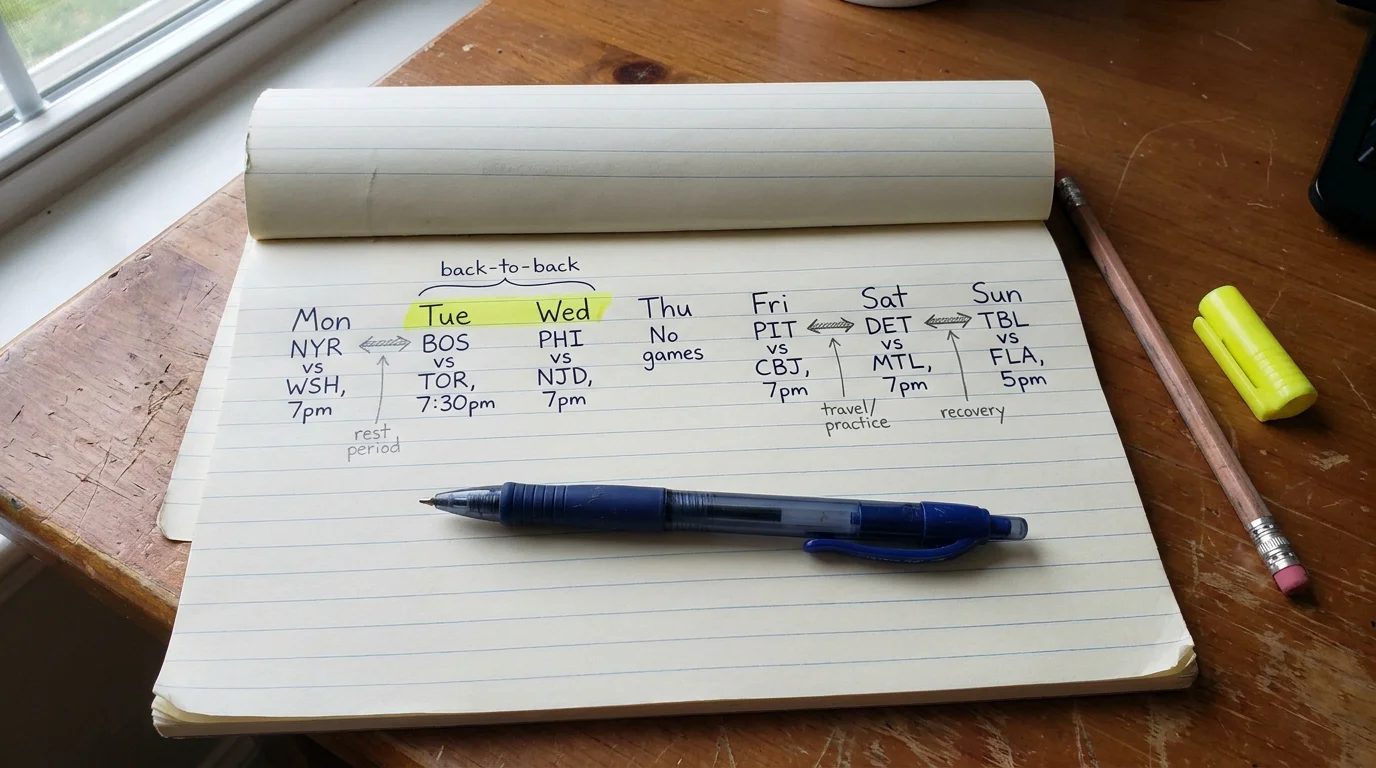
Ignoring Back-to-Back Schedules
NHL teams play 82 regular-season games. A meaningful percentage of those are back-to-backs — two games on consecutive nights, often with travel in between. The second game in a back-to-back is, on average, played at a reduced level. Save percentages drop, expected-goals output drops, shot quality drops. Backing -1.5 on a team playing the second of a back-to-back against a rested opponent is fighting against the schedule.
My pre-bet check is fixed: every puck line bet, I confirm both teams’ previous-game date. If the favourite played last night and the dog had two days off, I’m passing or flipping to +1.5 dog. This single filter eliminated about half of my losing puck line bets in years three through five.
Misreading Overtime and Shootout Settlement
Most UK punters don’t realise that overtime and shootout goals count as one goal in puck line settlement. That sounds obvious until you’ve been on the wrong side of it.
A 2-1 regulation result and a 2-1 overtime result settle identically for the puck line. Both are one-goal wins, regardless of whether the game ended in 60 minutes or 65 or via a shootout. The favourite at -1.5 loses in both cases. The dog at +1.5 covers in both cases. That OT-shootout structure is the biggest single reason +1.5 dogs win 62.8 percent of the time — empty-netters and overtime both work in their favour.
Buying the Line at Terrible Juice
Last point and it’s the one that hurts most over a long sample. The same -1.5 bet can be priced at -110 on one UK book and -130 on another. Over a season, the difference between paying -110 and -130 on 200 puck line bets is roughly the gap between breaking even and losing two units of your bankroll. Line shopping is the boring part of the job, but it’s the difference between profitable and break-even. Open at least three UKGC-licensed books before you click bet.
Four Numbers I Default To on Every Puck Line Bet
After nine years modelling NHL puck line value from a UK base, the framework comes down to four numbers and four habits. Treat them as non-negotiable filters and you’ll be sharper than 90 percent of the people pushing buttons on a Saturday night.
- 62.8 percent. The historical +1.5 underdog cover rate. It’s the foundation of the entire puck line edge. Every bet I build starts from this baseline and adjusts for matchup, rest and goaltending.
- 63.9 percent. Home dogs cover the spread at this rate. It’s the single most reliable angle on the NHL board, and the default starting point for any UK punter learning the market.
- 0.28 goals. The average home-ice edge per game. Small, but consistent enough that it tips a meaningful number of one-goal regulation losses into outright wins or overtime — and that’s the mechanism behind the home +1.5 advantage.
- 1.5 goals. The fixed standard spread on every NHL game. Anchor your thinking around that buffer. If you find yourself hoping for an empty-netter to cover, you’re playing for variance rather than edge.
The four habits: line shop across at least three UKGC-licensed books before every bet; confirm the starting goalies; check both teams’ rest schedules; and never bet a puck line on a coin-flip moneyline matchup.
Why is the NHL puck line almost always set at -1.5 or +1.5 instead of varying?
The 1.5-goal spread is hockey’s structural sweet spot. Average winning margin in regulation hovers around 1.6 goals, so a half-goal hook either side never pushes, while still tracking the realistic edge of the favourite. Anything wider would price the underdog out of the market; anything tighter would behave like the moneyline. Some UK bookmakers offer alternative puck lines at -2 or -2.5, but those operate as separate markets with their own dynamics — the standard product remains anchored at -1.5 and +1.5 across the entire NHL board.
Does an overtime or shootout goal count toward puck line settlement?
Yes. Overtime and shootout goals are worth one goal in puck line settlement on every UKGC-licensed sportsbook. A team that wins 3-2 after a shootout finishes with a one-goal official margin, identical to a 3-2 regulation win. That structure benefits +1.5 underdogs — roughly one NHL game in four ends in overtime or a shootout, and the dog at +1.5 covers automatically in those games. It penalises -1.5 favourites, who can win the game on the moneyline but lose the puck line bet because the OT or shootout result only counts as a one-goal win.
Can the puck line push and result in a stake refund?
The standard -1.5 and +1.5 puck line cannot push. The half-goal hook on either side ensures every bet has a winner — there are no draws on the spread. You either cover by a goal or more, or you do not. Alternative puck lines at -2 or +2 can push if the result lands exactly on the integer margin, and a push refunds your stake on most UK books. On the standard product offered by every UKGC-licensed sportsbook, though, no settled NHL game produces a refund.
Is the puck line better value than the moneyline for short-priced favourites?
Often yes. When a favourite is priced at -200 or shorter on the moneyline, the implied probability is 66.7 percent or higher, and the payout per pound staked is brutal. The -1.5 puck line on the same favourite usually sits between -110 and -130, giving you a near-even-money price on a team that wins outright more than two-thirds of the time. The catch is the margin requirement — they need to win by two or more, and one in four NHL games ends in overtime or shootout, automatically failing the -1.5 cover. The decision depends on whether the favourite is the kind of team that pulls away or grinds out one-goal wins.
