
 Available in US
Content

An NHL shots-on-goal prop is an over/under market on the number of shots a specific player will register on goal during a single regulation game plus overtime. The line is typically set between 2.5 and 4.5 shots for top forwards depending on their season-long shot rate, with high-volume shooters like Draisaitl — whose 52-goal pace in 2024/25 was supported by elite shot generation — often quoted at lines of 4.5 or higher. The market is fundamentally different from anytime goal-scorer props in one crucial respect: SOG markets do not depend on goals being scored. A player can register seven shots and zero goals and the SOG over is a winner. The mechanic is volume, not outcome, which makes the prop tradeable for an entirely different class of player than the AGS market.
I have spent nine years working NHL prop markets at UK-licensed sportsbooks, and the SOG prop has earned its place as one of the most consistently exploitable skater markets in the league. The reason is structural — shot volume is a more stable per-player metric than scoring rate, the public data is excellent, and the line-setting at most UK sportsbooks reflects season-long averages without enough adjustment for matchup-specific factors. The mismatch between stable underlying volume and reactive line-setting is where the edge lives. This piece walks through how SOG totals are priced, where high-volume shooters create persistent value, the role of game script, and the contexts where SOG overs fail despite favourable pre-match conditions.
How SOG totals are priced
The structural baseline for any SOG prop line is the player’s season-to-date average shots-on-goal per game, with the smoothing weight from the prior season’s average added where the current-season sample is still small. A forward averaging 3.2 shots per game has a baseline expectation that the operator typically sets at 2.5 or 3.5 — the half-shot increments are designed to avoid push outcomes — and the matchup adjustments are then layered on. Faster-paced opponents that allow more shots per game push the line up; slow-paced opponents pull it down. The detail in which operators apply those adjustments varies; some sportsbooks publish lines that have not been adjusted at all from the season-long baseline, which is where the cleanest edges appear.

The fractional pricing on SOG over/under is typically tighter than AGS pricing because the market is binary in a different way. Each side of the SOG total — over and under — is usually quoted between 5/6 and 10/11, with the difference reflecting the operator’s read on which side is more likely to hit. The smaller fractional spread means the implied probabilities are closer to 50/50, and the structural edge comes from identifying matchups where the actual probability is meaningfully above or below 50 percent. A line set at 3.5 shots for a player whose true expected volume is 4.1 in this specific matchup is the kind of mispricing that compounds across enough SOG tickets to produce a real edge over a regular-season sample.
High-volume shooters and persistent edges
The structural reality of NHL shot rates is that a small group of players consistently produce shot volumes well above league average. Defencemen like Cale Makar who get heavy ice time on top-pair units, centres on first-line scoring units, and the small number of forwards whose role specifically emphasises shot generation — all of these players post shot rates that put them at the top of the league’s per-game distribution. Kucherov’s 121-point 2024/25 season was built partly on high shot volume that translated into both goals and assists; his AGS market is one set of tickets, his SOG market is a parallel and partly independent set. The connection between high shot volume and goal-scorer probability runs through the AGS prop market specifically, and the framework I lay out in my piece on how to pick NHL AGS props with a statistical edge covers the cross-market relationship in detail.

The structural lesson for SOG betting is that high-volume shooters tend to retain their volume across matchups that the market sometimes prices as if it should suppress it. A 4-shot-per-game forward facing a defensively-strong opponent might be priced at 3.5 shots over/under, with the under at 5/6, on the assumption that the matchup will suppress volume. In practice, top-line forwards with established roles tend to take their volume regardless of opponent — the shots may not produce as many goals, but the shot rate itself is sticky. Backing the SOG over on high-volume shooters in matchups where the line has been pulled down from their season baseline is one of the more reliable structural angles in NHL prop betting.
Game script and SOG
The single biggest situational variable in SOG betting is game script — the way the score evolves across the three periods and how that affects shot distribution. A team trailing 3-1 in the third period typically generates more shots than a team leading 3-1; the trailing team pushes for the comeback, while the leading team plays a more conservative structure that suppresses shot generation. The implication for SOG betting is that the same player on the same matchup can have meaningfully different shot expectations depending on how the game is likely to unfold. Pre-match SOG lines cannot price this perfectly because the script is not yet known.
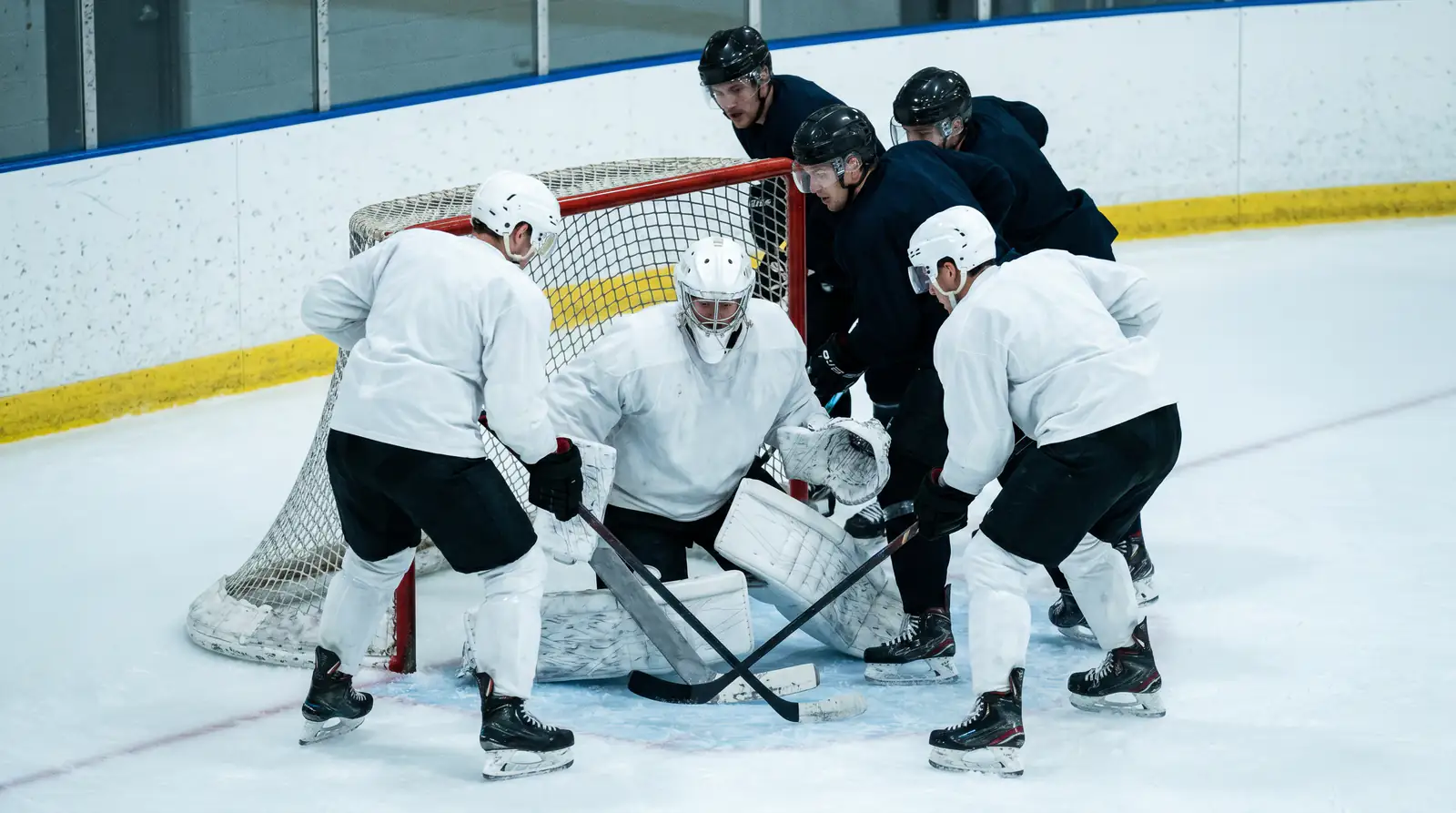
The structural read I find most useful on game-script questions is to lean toward SOG overs on players from teams that are moderate underdogs at home. The combination is structurally favourable for shot generation — the team is competitive enough not to be blown out (which would produce a low-volume garbage-time situation), but is more likely than not to spend periods of the game chasing the score, which lifts shot rates across the lineup. The mirror image — backing SOG unders on players from teams that are heavy favourites — works on the same logic in reverse. The most reliable SOG edges in my workflow come from these game-script-aware adjustments rather than from any single per-player metric in isolation.
When SOG overs fail despite favourable conditions
The most common pattern I see when a SOG over fails on what looked like a favourable pre-match setup is reduced ice time — typically a result of an early penalty, an in-game injury, or a coaching decision to bench a struggling player. A forward whose pre-match SOG over at 3.5 shots was priced on 18 minutes of expected ice time will not hit the over if their actual ice time falls to 13 minutes, regardless of how favourable the matchup looked. The structural risk on SOG overs is concentrated in ice-time variability, and this is the factor the market itself has the least ability to price pre-match.

The second failure mode is unexpectedly fast game script working against the player’s team in a way that flips the script-favourability assumption. A team that was expected to be a moderate underdog chasing the game from behind might instead jump to a 2-0 lead, and the structural conditions that favoured shot volume from the chase position disappear entirely. The shots get distributed across the lineup more evenly, the team plays a more conservative structure with the lead, and the specific player whose volume was projected to be elevated by chase dynamics instead ends up at or below their season baseline. The honest accounting is that SOG overs require not just shot generation talent but also the game state to cooperate.
The SOG framework I lean on across the regular season
The single piece of work that produces the most reliable SOG edges in my workflow is comparing the operator’s SOG line to my own season-baseline projection adjusted for game-script expectations. Most SOG lines I see at UK sportsbooks are set within plus or minus 0.3 shots of the season-long average, which leaves room for matchup-specific adjustments to identify genuine value. High-volume shooters in chase-script situations against opponents that allow above-average shot rates are the spots I bet most aggressively. High-volume shooters in lead-script situations against defensively-strong opponents are the spots I fade. Draisaitl’s 52-goal pace in 2024/25 was built on consistent shot volume that the SOG market sometimes priced too cautiously; the structural pattern is replicable across any high-volume shooter on the right matchup setup. The work is the matching, and the discipline is sizing the position appropriately so that the inevitable failure modes — early penalties, in-game injuries, unexpected lead scripts — do not damage the bankroll across the variance band.

Do blocked shots count toward an NHL shots on goal prop?
No. Only shots that reach the goaltender — saves and goals — count toward SOG. Blocked shots and shots that miss the net are excluded. A player can register four or five shot attempts in a game with only two or three counting toward SOG settlement.
How are SOG props graded if a skater is injured mid-game?
Most UK-licensed sportsbooks settle SOG props on whatever total the player accumulates regardless of completion. Two shots in the first period followed by an injury ruling typically settles at two shots. Some operators offer void rules for early injuries without meaningful shot accumulation, but the default is the prop plays.
