
 Available in US
Content

The anytime goal scorer (AGS) prop is the simplest skater-market bet in NHL — a binary yes-or-no on whether a named player will score at least one goal at any point during regulation and overtime. The market is everywhere across UK-licensed sportsbooks, the pricing is intuitive, and the variance characteristics give it a structural place in any disciplined hockey betting workflow. Leon Draisaitl scored 52 goals across the 2024/25 regular season — that translates to roughly a 0.63 goal-per-game rate, which means his anytime goal-scorer probability hovered around 47 to 50 percent across the typical regular-season game. The AGS market on Draisaitl trades around that band, sometimes slightly tighter, sometimes slightly wider, and the question for the bettor is always whether the operator’s price is leaving room.
I have spent nine years working AGS markets across multiple UK sportsbooks, and the prop has earned a structural place in my workflow for two reasons. First, the underlying probability is genuinely calculable from public data — goals-per-game rates, line-mate effects, and matchup-specific adjustments produce a defensible estimate that can be compared to the market price. Second, the market itself is softer than the moneyline or totals because the volume per ticket is smaller, which means the trading desks pay relatively less attention to the precise pricing. The American Gaming Association’s Bill Miller summed up the partnership context with the league succinctly — “Educating patrons about how to engage in this activity responsibly is critical to the success of the sports betting opportunity as it continues to expand throughout the country. We’re thankful for the NHL’s continued leadership on responsible sports betting.” The educational framing matters because the AGS market specifically rewards bettors who have done the work and punishes those who have not. This piece walks through how prices form, the shot-volume relationship, line-mate effects, and what UK sportsbooks actually offer in the AGS prop space.
How AGS markets are priced
The structural baseline for any AGS price is the player’s goals-per-game rate over a meaningful sample — typically the current season plus a smoothing weight from the prior two seasons. A player averaging 0.5 goals per game has an underlying anytime-scorer probability of around 39 percent under a Poisson distribution, before any matchup-specific adjustments. The matchup adjustments are then layered on — opposing goaltender quality, the player’s line-mates and the rest of the unit’s expected ice time, special-teams usage, and recent form within the last 10 to 15 games. The product is a fair-value implied probability that can be compared directly to the operator’s quoted price.

The market typically quotes top scorers at fractional prices between 5/4 and 7/4 — implied probabilities of 36 to 44 percent — with second-line forwards in the 11/4 to 4/1 range and bottom-six skaters at 6/1 or longer. The pricing spread reflects the underlying goals-per-game distribution across the league. The structural reality is that only a small minority of NHL players post anytime-scorer probabilities above 40 percent in any given game, and the prop is most often a fractionally-priced underdog from the customer’s side. The trick is identifying which underdogs are well-priced relative to their structural chances — Kucherov’s 121-point season in 2024/25 produced an unusual cluster of nights where his AGS probability exceeded 45 percent on favourable matchups, and the market did not always price those nights aggressively enough.
Shot volume correlation with AGS hit rate
The single best public-data signal for AGS hit rate is the player’s shots-on-goal rate over a recent sample. Goals are scored from shots; players who shoot more often score more often. A player averaging 3.5 shots on goal per game has a structurally higher AGS probability than a player averaging 2.0, even controlling for shooting percentage. The mechanics are straightforward — more shots produce more lottery tickets in the per-shot scoring conversion, and the variance evens out over time. The detailed mechanics of how the shot-volume prop market itself trades, and where the relationship between shot volume and goal scoring is most tradeable, is something I cover in my piece on how NHL shots-on-goal props work as a volume-driven skater market, because the SOG prop and the AGS prop are mechanically connected in a way most bettors do not fully exploit.

The mathematical relationship is roughly that AGS probability tracks shots-on-goal rate multiplied by shooting percentage, with a small adjustment for the actual game-context distribution of shots versus the average. A player averaging 4 shots on goal per game with an 11-percent shooting rate has a structural anytime-scorer probability around 40 percent under standard Poisson assumptions, with matchup-specific adjustments either pushing that higher or lower. The structural read is that backing high-shot-volume forwards on matchups against weaker goaltenders is one of the more reliable AGS edges, because the shot rate is the primary driver and the goaltender adjustment is where the matchup-level edge lives.
The line-mate effect on AGS probability
The factor most often underweighted by casual AGS bettors is who the player is actually skating with. A second-line forward bumped up to the top line for a single game due to injuries upstream is operating in a different ice-time environment than their season-long usage suggests, and their AGS probability shifts significantly upward as a result. The mirror image applies — a top-line forward demoted to a third-line role for matchup reasons sees their AGS probability drop by similar magnitudes. Line-combination news is one of the few information sources that consistently moves AGS pricing in the right direction, but the market lag between the news being public and the price being adjusted is sometimes wide enough to be tradeable.
The structural read on line combinations matters most when the change involves a player moving onto or off a top power-play unit. NHL power-play ice time concentrates scoring chances heavily — the league’s 21.6 percent power-play conversion rate in 2024/25 produced a meaningful share of total goals, and the players who get top-unit power-play ice are at a structural AGS advantage over those who do not. A bottom-six forward bumped onto the second power-play unit for a single game has a higher AGS probability than their season-long average suggests, and the market sometimes catches up only after the line confirmation has been public for an hour or two.

UK bookmaker AGS markets and prop builders
Most major UK-licensed sportsbooks offer AGS markets on the bulk of skaters across the typical NHL slate — top-line forwards always, second-line forwards usually, third-line and bottom-six forwards selectively depending on the matchup, and defencemen in the small minority of cases where a player’s offensive role justifies the market. The depth varies across operators. Some sportsbooks publish 12 to 15 AGS markets per game with prices for both teams’ skaters; others stick to the top six to eight forwards from each team and skip the rest of the rosters.
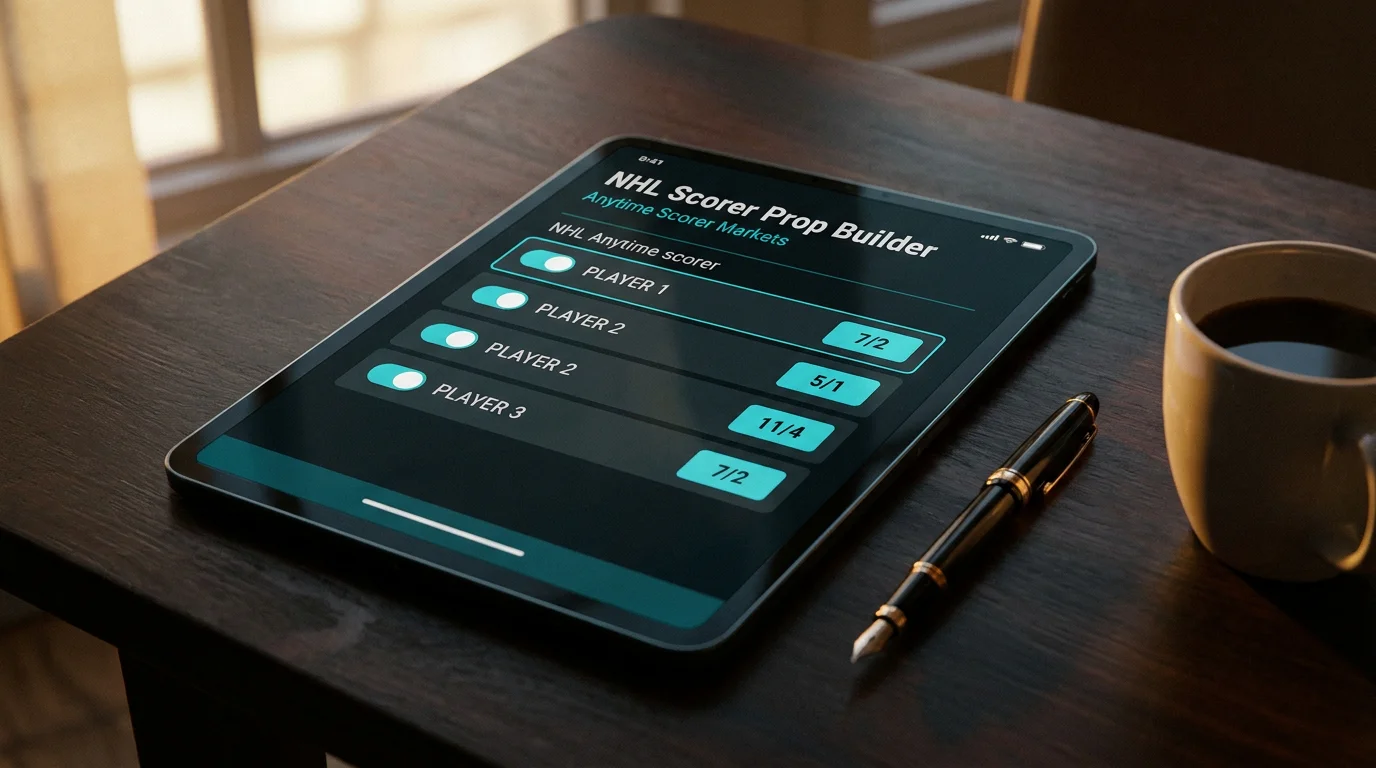
The prop builder feature on most major UK sportsbooks lets bettors combine multiple AGS selections into a single ticket at parlay-style pricing, with two or three legs being the typical structure. The mathematics of these multi-leg AGS tickets matter — combining two players at 40 percent implied probability each produces a 16 percent combined probability under independence assumptions, and the market price should reflect that. In practice, the prop builder pricing on major UK sportsbooks is usually competitive on two-leg AGS tickets and substantially margined on three-leg or longer combinations, which means the disciplined approach is usually to stick with two-leg combinations or single AGS tickets rather than building deeper parlays.
The AGS framework I use across the regular season
The single most useful piece of work I do on AGS markets is comparing the player’s shots-on-goal rate over a recent 10-game sample to their season baseline. Players whose recent shot rate is meaningfully above their season average — usually by more than 0.5 shots per game — are in a structural form window that the market often has not fully priced. Combined with a favourable goaltender matchup and confirmed top-line or power-play deployment, those spots are where the most reliable AGS value lives. Draisaitl’s 52-goal pace in 2024/25 was the product of exactly this kind of compound positioning — high shot volume, top-line deployment, and special-teams usage stacking on top of each other. The structural pattern is the same for any AGS contender on any night of the season. The work is identifying the conditions before the market does, and pricing the AGS ticket accordingly.

Does an empty-net goal count for an NHL anytime goal scorer prop?
Yes in almost all UK sportsbook AGS markets. Empty-net goals score as goals for prop settlement purposes. The exception is timing — most operators settle AGS at end of regulation plus overtime, with shootout goals excluded. Empty-net inclusion is meaningful because late EN goals concentrate in close games.
Why is the AGS market often softer than the moneyline?
Per-ticket volumes are smaller, trading desks allocate less continuous attention, and closing prices are less aggressively arbitraged than the moneyline. The structural consequence is that genuine AGS edges persist longer than equivalent moneyline edges — which is what makes disciplined AGS work one of the more reliable forms of NHL betting.
