
 Available in US
Content

NHL live betting is the in-play market where prices update dynamically as the game unfolds — every goal, every power play, every goaltender pull moves the moneyline, totals, and prop lines in real time. The UK real-event betting market hit £508 million in Q2 of the 2025/26 fiscal year, a number that captures how much in-play activity now runs through UK-licensed sportsbooks across all sports. Hockey contributes a meaningful slice of that volume during the regular season, particularly during UK overnight hours when North American games are running and the broader sports calendar is quiet. The 1,312-game regular season produces in-play opportunities almost every night for the UK bettor who knows how to read momentum shifts cleanly.
I have spent nine years watching how NHL live markets move, and the in-play game is structurally different enough from pre-match betting that the same analytical framework cannot be applied without modification. Pre-match work is about pricing the game before it starts; live work is about reading what the game is actually doing and identifying where the market’s reaction to events has overshot or undershot the structural information. Andrew Rhodes, the former UK Gambling Commission chief executive, put the broader UK gambling data picture in context — “The Gambling Survey for Great Britain is a key building block of the evidence base which helps government, industry and other partners understand both gambling behaviour and potential consequences from gambling.” The data is the input. The behaviour is what produces the live mispricings that disciplined in-play bettors find. This piece walks through how markets shift, a specific case study, totals strategy, and the UKGC rules that frame live betting at licensed sites.
How live markets shift
The fundamental mechanic of NHL live betting is that the price reflects the game state plus the time remaining. A team trailing 1-0 after twenty minutes is a different ticket than the same team trailing 1-0 after fifty minutes — the structural shot at coming back depends on how much hockey is left to play. The moneyline shifts second-by-second to reflect goals, penalties, power plays, and the time decay between events. Most major UK sportsbooks update prices within five to ten seconds of significant in-game events, with the closing window for in-play bets typically falling in the final minute or two of regulation.
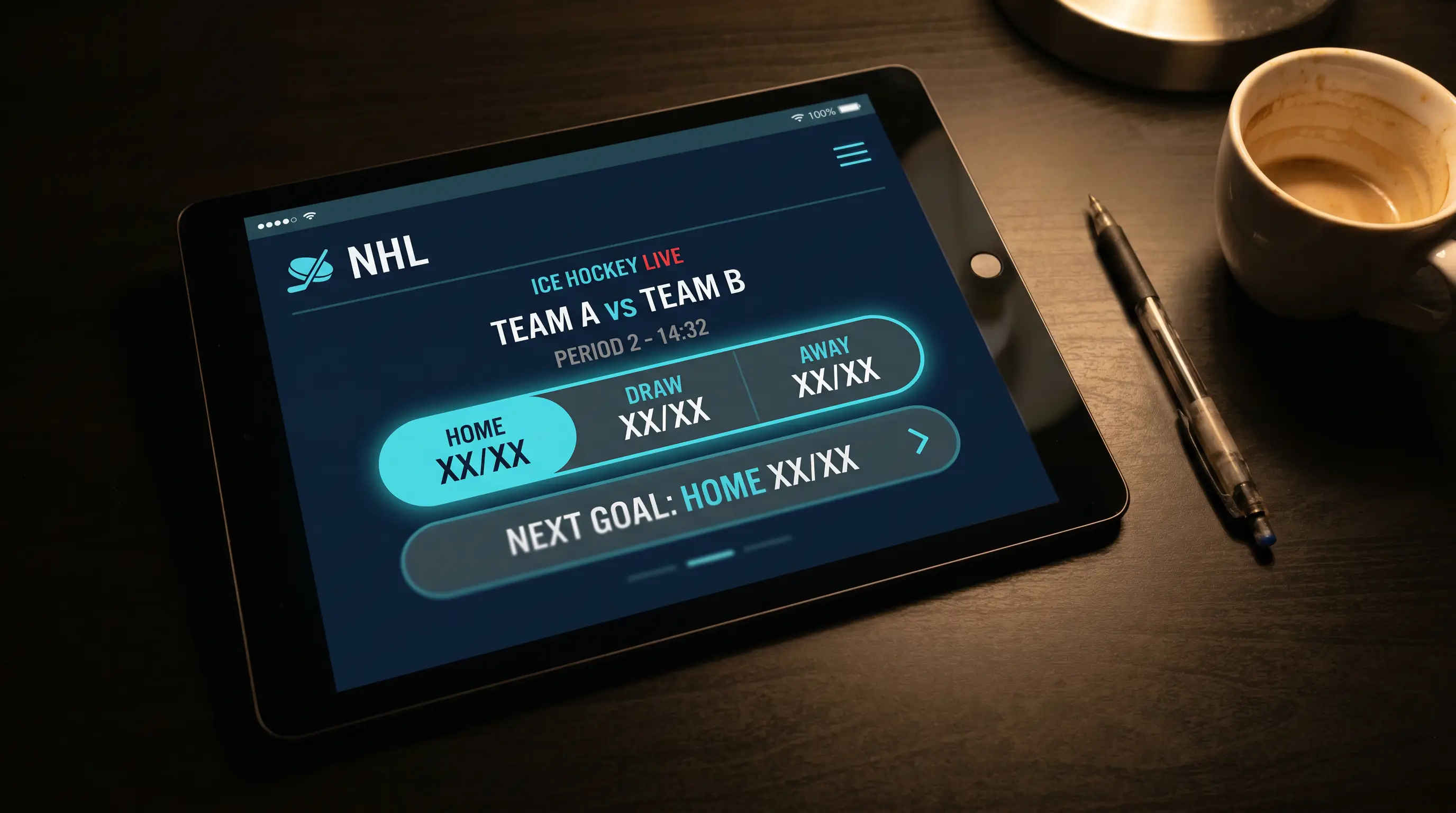
The market behaviour I find most exploitable is the post-goal overreaction. A team scores to take a 2-1 lead, and the moneyline on the trailing side often shifts further than the structural read justifies — a goal in the second period moves a 50-percent moneyline to roughly 35 percent on the underlying probability, but the market sometimes prices it as low as 28 percent in the first thirty seconds of overreaction before settling back to fair value within a minute. The window is narrow but real, and the bettor who has done the pre-match work and is waiting for the in-play opportunity can capture the gap. The framework I lay out in detail in my piece on how period-level NHL betting works across first, second and third-period markets applies directly here — period structure is the temporal frame within which live moves happen.
Case study — the Rangers comeback at -120 to +340
The cleanest case study I keep returning to in coaching anyone on NHL live betting is a Rangers game from 2023 that has become a structural reference point in the public coverage. The Rangers opened as pre-match favourites at minus 120, fell behind 2-0 in the first period, and their in-play moneyline blew out to plus 340 by the second intermission. A pre-match read that had them as a coin-flip favourite was now pricing them as a 22-percent underdog, despite the same team being on the ice with 40 minutes of hockey remaining. The structural read on the comeback probability — a team down two goals with two periods to play has roughly 15 to 20 percent chance of winning in regulation plus another 5 to 8 percent of forcing overtime — was substantially better than the implied 22 percent the market was offering once you accounted for overtime equity.

The Rangers won the game in overtime. The point of the case study is not that the comeback bet was a lock — it was not — but that the live market had overshot the structural read by enough to make the ticket a clean positive-expectation bet at the 22-percent implied probability the market was offering. The same overshoot happens regularly on live NHL markets, particularly in the minutes immediately after a goal that shifts the narrative. The work is not chasing every comeback ticket, which would lose money; the work is identifying the spots where the market has moved further than the structural read justifies and entering only those tickets.
Live totals strategy
Live totals markets in NHL betting are where some of the most consistent value lives, and the strategy framework is different from live moneyline work. Pre-match totals are set based on team pace metrics, goaltender quality, and expected special-teams contribution. Live totals shift based on the current scoreline relative to game time — if a game is 2-1 after twenty minutes, the live total is typically pushed up sharply as the market projects the second-and-third-period pace from the first-period rate. The projection often overshoots, especially when the first period produced multiple early-game special-teams sequences that are not representative of the structural pace.

The cleanest pattern I work with on live totals is the second-period under, taken when the first period produced two or three goals on power-play sequences that depleted the available power-play minutes for the remainder of the game. The market projects forward as if the first-period scoring rate is the new pace; the structural read is that special teams have already produced their share, and the second period is likely to revert toward even-strength scoring at a lower rate. The pattern does not always hit — periods producing three or four goals on flow plays follow a different path — but where the first-period scoring is special-teams concentrated, the under in subsequent periods is a structurally cleaner bet than the market is typically pricing.
UKGC live betting rules
The UK Gambling Commission’s framework for live betting overlays on top of the broader licensing regime that governs UK sportsbooks. Real-time betting is permitted under the standard sportsbook licence, but the operator is required to apply the same KYC, source-of-funds, and safer-gambling checks that govern pre-match betting. The £150 financial vulnerability check threshold applies to net deposits regardless of whether the bets placed within that net total were live or pre-match. The UKGC has also mandated certain market suspensions during live broadcasts — typically the final seconds of regulation in close games — to prevent the kind of latency arbitrage that exploits delays between live action and market pricing.

Cash-out is the live-betting feature most UK bettors interact with daily, and the UKGC requires operators to display cash-out values clearly with the implicit margin embedded. Most operators offer cash-out on the bulk of live NHL bets, but the cash-out price typically includes a meaningful margin against the customer compared with the underlying market — a bettor accepting cash-out on a winning ticket is usually settling for less than the structural fair value of the position. Using cash-out is a tool, not a strategy, and the better default is usually to ride the ticket to its natural conclusion unless a specific reason to lock in the result presents itself. The 22.5 million UK adults using the regulated sector monthly are all operating within this framework, and the protections it provides are the structural reason live betting at UK-licensed operators is meaningfully safer than at offshore sites.
The live-betting discipline that keeps me on the right side of variance
The work that has paid back most reliably across nine years of NHL live betting comes down to a single discipline — only betting live when the pre-match preparation has identified a specific scenario worth waiting for. Random in-play tickets, placed on impulse after watching a few minutes of a game, are a slow drain on the bankroll. Pre-identified scenarios — the second-period under after special-teams-heavy first periods, the post-goal comeback ticket when the market has overshot, the late-game cash-out decision on a winning position — are where the structural edges live. The £508 million in UK real-event betting that ran through Q2 of 2025/26 is the volume that makes the markets work; the discipline of operating selectively within that volume is what separates a profitable live bettor from a busy one.

How fast do NHL live moneyline prices move after a goal?
Most UK-licensed sportsbooks update live prices within five to ten seconds of in-game events. New equilibrium typically forms within 30 to 90 seconds. The overreaction window — where the market overshoots the structural read — is usually the first 10 to 30 seconds before sharp money rebalances.
Do UK bookmakers always offer cash-out on in-play NHL bets?
Most major UK-licensed sportsbooks offer cash-out on the bulk of live NHL bets but coverage is not universal. Thinly-traded prop markets are often excluded, and operators reserve the right to suspend cash-out in volatile moments. The cash-out price typically embeds a meaningful margin against the customer.
